

Democrats Warn Trump Tariffs Could Damage U.S.–India Relations
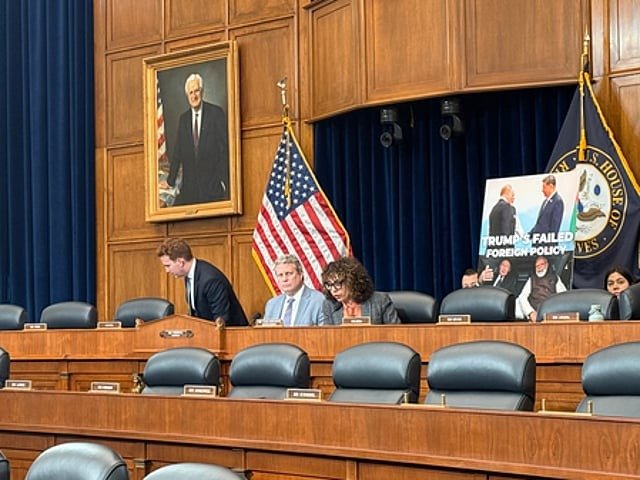
A heated debate unfolded in Washington as Democrats sharply criticized President Donald Trump’s escalating tariff measures against India, warning that his approach could jeopardize one of America’s most important global partnerships. The warnings came during a Congressional hearing held by the House Foreign Affairs Subcommittee on South and Central Asia, where concerns over deteriorating relations between Washington and New Delhi took centre stage.
Democrats Sound Alarm Over Strategic Fallout
Rep. Sydney Kamlager-Dove, the ranking Democratic member of the subcommittee, delivered an especially strong critique. She argued that Trump’s confrontational stance, combined with steep tariff hikes, threatens to undo decades of bipartisan work that strengthened ties between the world's largest democracies.
Kamlager-Dove said the Biden administration left Trump with a “bilateral relationship at the height of its strength,” pointing to key achievements: a revitalized Quad alliance, growing cooperation in defence and emerging technologies, and India’s expanding role as a trusted partner in global supply chains. Instead of building on this foundation, she said, Trump’s actions are pushing India away.
Her message was direct and stark:
“Unless he changes course, Trump will be the American President who lost India.”
She added that alienating a strategic partner does not earn international respect or accolades:
“You do not get a Nobel Peace Prize by driving strategic partners into the arms of our adversaries.”
Tariffs at the Core of the Dispute
The hearing focused heavily on Trump’s “Liberation Day tariffs,” which imposed a 25% duty on Indian goods, followed by another 25% surcharge on India’s imports of Russian oil. Combined, these measures place a 50% tariff burden on India — a rate higher than what the U.S. currently applies to China.
Democrats and experts called the strategy counterproductive at a time when Washington is seeking allies to counter China’s influence, strengthen supply chain resilience, and promote economic stability across the Indo-Pacific.
Kamlager-Dove declared the tariff structure “self-defeating,” noting that it not only strains the relationship but also undermines U.S. strategic objectives in Asia.
Concerns Over People-to-People Ties
In addition to economic tensions, Democrats criticized Trump for imposing a controversial $100,000 fee on H-1B visas, the majority of which are issued to Indian professionals. Kamlager-Dove contended that the policy punishes a community that has made remarkable contributions to the U.S. economy, including in technology, science, medicine, and academia.
She argued that such measures weaken cultural and economic bridges that historically supported and strengthened the U.S.–India relationship.
Expert Testimony Points to Negotiation Progress
Dhruva Jaishankar of ORF America testified that trade talks between the U.S. and India had made significant progress earlier in the year. Negotiations reportedly began before February 13, and by July, both sides were “quite close” to reaching a deal. Jaishankar insisted that India remains open to cooperation and is actively pursuing free trade agreements with multiple partners.
According to him, a mutually beneficial trade solution remains within reach — but only if Washington demonstrates the political will to move forward.
Witnesses also warned that lingering trade disputes risk overshadowing urgent strategic priorities. These include deterring China in the Indo-Pacific, diversifying global supply chains, and deepening collaboration in defence technologies and critical minerals.
A Low-Cost, High-Reward Partnership at Risk
Another expert, Smith, described the U.S.–India relationship as historically “low-cost and high-benefit” for Washington. He cautioned lawmakers against jeopardizing trust built over many decades.
“It would be strategic malpractice of the highest order to discard the trust we have built,” Smith told the committee, underscoring that cooperation with India has provided the U.S. with meaningful geopolitical advantages at minimal cost.
A Pivotal Moment for U.S.–India Relations
The hearing made clear that the tariff confrontation has become the most contentious issue shaping U.S.–India relations today. Lawmakers across party lines expressed concern that continuing down this path could have lasting geopolitical consequences.
As global power dynamics shift and China’s influence expands, the U.S.–India partnership is widely viewed as central to maintaining balance in Asia. Democrats argue that alienating India now — through tariffs, restrictions, and confrontational rhetoric — could weaken America’s strategic position for years to come.
Whether the Trump administration will reconsider its approach remains uncertain, but experts insist that the window for repairing the damage is narrowing.