

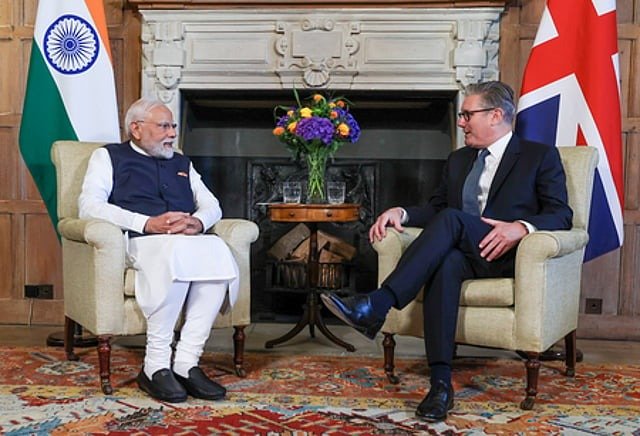
Starmer Rules Out Relaxing Visa Rules for India Ahead of Trade Mission
<p><strong>London:</strong> British Prime Minister <strong>Sir Keir Starmer</strong> has confirmed that the United Kingdom will not relax visa rules for Indian citizens, even as he prepares to lead a major trade delegation to India next week.</p><p>Speaking ahead of his first official visit to the country as Prime Minister, Starmer made it clear that his government’s focus lies in <strong>boosting trade, investment, and cultural collaboration</strong> — not in altering immigration policy.</p><p>“The issue is not about visas,” Starmer told reporters during his flight to Mumbai. “It’s about business-to-business engagement, investment, jobs, and prosperity coming into the United Kingdom.”</p><p>His comments come amid growing anticipation about whether the UK’s new Labour government would soften visa policies as part of its efforts to deepen ties with India — especially after the signing of a <strong>long-awaited UK-India Free Trade Agreement (FTA)</strong> earlier this year.</p><h3><strong>Trade and opportunity at the heart of the visit</strong></h3><p>Starmer’s trip marks an important step in resetting post-Brexit relations between the UK and one of its fastest-growing trading partners. The British leader will be accompanied by a high-level delegation of <strong>over 100 entrepreneurs, investors, university chancellors, and cultural leaders</strong>, highlighting the importance of education, innovation, and business cooperation between the two nations.</p><p>“The opportunities for collaboration between the UK and India are enormous — in technology, renewable energy, education, and the creative industries,” Starmer said. “This visit is about making sure those opportunities are realised.”</p><p>The UK-India trade deal, finalised in <strong>July 2025 after nearly six years of negotiation</strong>, aims to cut tariffs and streamline market access for key sectors. Under the agreement, <strong>Indian textiles and jewellery</strong> entering the UK will face reduced tariffs, while <strong>British automotive and spirits exports</strong> to India will become cheaper.</p><p>The deal is expected to <strong>boost bilateral trade by billions of pounds</strong>, creating thousands of new jobs and opening new supply chain pathways across both nations.</p><h3><strong>No visa concessions — immigration policy remains firm</strong></h3><p>Despite the optimism around trade, Starmer’s firm stance on immigration marks a continuation of the UK’s tightening visa regime. His Labour government has faced political pressure to <strong>reduce overall migration numbers</strong>, particularly following a record influx of skilled and student migrants in recent years.</p><p>Government officials clarified that the new FTA includes <strong>no additional visa routes</strong> for Indian workers or students. However, one concession has been introduced — a <strong>three-year social security exemption</strong> for Indian employees on short-term UK work visas. This clause aims to prevent double taxation and make it easier for Indian professionals on temporary assignments.</p><p>Even so, Starmer emphasised that <strong>immigration reform is not part of the trade agenda</strong>. “The deal is about trade, not visas,” he reiterated.</p><p>During his flight, the Prime Minister was asked whether the UK might relax visa pathways to attract global tech talent — particularly after recent changes in the U.S. H-1B visa policy under President Donald Trump. Starmer responded that while the UK welcomes <strong>“top global talent”</strong> to drive innovation, there are <strong>no plans to introduce new visa categories specifically for India.</strong></p><h3><strong>Business delegation to boost connectivity</strong></h3><p>Several major British companies are joining the Prime Minister’s visit to explore new ventures in India. <strong>British Airways</strong> has announced plans to add a <strong>third daily flight</strong> between Delhi and Heathrow next year, while <strong>Manchester Airport</strong> will introduce a new <strong>direct route to Delhi</strong>, enhancing connectivity between the two countries.</p><p>The delegation will also focus on promoting education and research partnerships, particularly between British universities and Indian institutions. Academic cooperation is expected to feature prominently in Starmer’s meetings with Indian government and business leaders.</p><h3><strong>Meeting with Modi and regional diplomacy</strong></h3><p>During the two-day visit, Starmer is set to meet <strong>Prime Minister Narendra Modi</strong> in New Delhi to discuss expanding the trade relationship, regional stability, and cooperation on climate and technology.</p><p>The visit comes just days after Modi publicly extended birthday wishes to <strong>Russian President Vladimir Putin</strong>, a gesture that drew media attention in the West. Asked whether he would do the same, Starmer firmly dismissed the idea.</p><p>“Just for the record, I haven’t sent birthday congratulations to Putin, nor am I going to do so,” he said. “I don’t suppose that comes as a surprise.”</p><p>Starmer also avoided direct criticism of India’s purchase of discounted Russian oil but noted that the UK remains deeply concerned about Moscow’s use of the <strong>‘shadow fleet’</strong> — unregulated oil tankers transporting Russian crude in violation of Western sanctions.</p><p>“The UK has been one of the leading countries tackling the shadow fleet issue,” Starmer said. “We are determined to ensure that global energy markets remain transparent and compliant.”</p><h3><strong>Building a modern partnership</strong></h3><p>Analysts say Starmer’s upcoming visit signals a pragmatic approach — <strong>focusing on trade and economic ties while avoiding contentious political issues</strong> such as immigration or human rights.</p><p>While India remains keen to secure easier mobility for its skilled workers, the UK’s domestic priorities — including lowering migration and reviving economic growth — make such concessions unlikely in the near term.</p><p>Still, both nations view their partnership as <strong>strategic and long-term</strong>. With trade, education, and technology cooperation at the forefront, Starmer’s visit could help chart a new phase in UK-India relations — one that prioritises mutual economic gains over political symbolism.</p>