

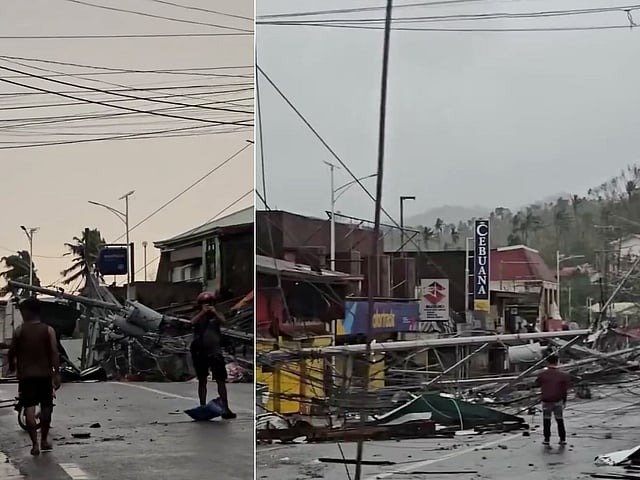
Storm Opong Batters Eastern Philippines, Leaves 5 Dead and Millions Without Power
Manila: Eastern Philippines is reeling from the devastating impact of Severe Tropical Storm Opong (international name Bualoi), which made multiple landfalls between Thursday evening and early Friday morning. The storm has left at least five people dead, displaced thousands, and knocked out power across entire provinces.
Dawn of Destruction
Opong first struck Eastern Samar late Thursday before hitting Masbate’s Palanas town at 4 a.m. on Friday. With sustained winds of 95 km/h and gusts reaching 115 km/h, the storm unleashed a barrage of heavy rains, violent winds, and storm surges up to two meters along coastal areas.
Videos captured by residents show harrowing scenes: palm trees bending like twigs, electric poles collapsing onto waterlogged streets, and roofs ripped away by gale-force winds. One clip from Masbate’s shoreline revealed massive waves battering seawalls, foam exploding into the air like geysers while residents prayed for safety.
Ground reports described debris swirling in the air, streetlamps crashing down, and communities plunged into darkness as the storm carved its destructive path.
Power Cuts and Stranded Families
The provinces of Samar, Masbate, and Sorsogon bore the brunt of widespread blackouts. Millions of households were left without electricity as transmission lines crumbled under the storm’s force.
Authorities confirmed that over 1,600 passengers were stranded at Bicol ports as swells reaching 3 meters made sea travel impossible. Ferries were grounded, leaving families separated and vital supplies delayed.
The state weather bureau PAGASA warned that while Opong had moved westward into the West Philippine Sea, its lingering effects could still enhance the southwest monsoon (habagat), bringing prolonged rains and flooding risks in Metro Manila and Southern Luzon through the weekend.
Casualties and Displacement
At least five fatalities have been confirmed: two victims buried in landslides in Samar and three drowned in flash floods. Local governments fear the toll may rise as reports from remote areas continue to come in.
Evacuation centers across the Bicol and Eastern Visayas regions now host more than 20,000 displaced residents who fled their homes at the height of the storm. Families huddled in makeshift shelters, relying on rice packs, canned goods, and clean water provided by the Department of Social Welfare and Development (DSWD) and local authorities.
Government Response
President Ferdinand Marcos Jr. announced the release of ₱1 billion in immediate relief funds to accelerate disaster response and recovery. He urged solidarity among Filipinos, stressing that “the strength of the nation is tested in moments like this, and together we will rebuild stronger.”
Relief convoys carrying water purifiers, food packs, and tarpaulins have already been dispatched to Masbate and Samar. The Philippine Coast Guard and Philippine Army mobilized personnel to clear roads, remove toppled electric posts, and deliver aid to hard-hit coastal barangays.
Opong Aftermath and Regional Threat
While local responders work to restore order, Opong’s impact extended beyond the Visayas. In Iloilo’s Sicogon Island, rescuers counted dozens of damaged homes and fallen billboards, while storm surges inundated fishing villages.
The storm’s trajectory shows it re-intensifying over the West Philippine Sea on its path toward Vietnam, prompting forecasters to issue maritime warnings across the South China Sea.
Opong comes on the heels of Super Typhoon Ragasa, which battered Northern Luzon just a week earlier, causing landslides in Benguet and widespread flooding in Ilocos provinces. The back-to-back storms underscore the Philippines’ vulnerability to extreme weather events fueled by climate variability.
Spirit of Resilience
Despite the destruction, stories of resilience continue to emerge. In Masbate, survivors gathered in prayer circles outside damaged chapels, giving thanks for spared lives even as homes lay in ruins. Volunteers, from student groups to parish workers, have joined relief efforts, proving that community spirit remains unbroken.
Conclusion
As Severe Tropical Storm Opong moves away from the Philippines, its scars remain visible across Samar, Masbate, and surrounding provinces. With five lives lost, thousands displaced, and millions without power, the road to recovery will be long. Yet, amid adversity, Filipinos once again demonstrate their enduring resilience — a nation battered but never broken.