

Trump Imposes $100K H-1B Fee, Launches $1M Gold Card Residency
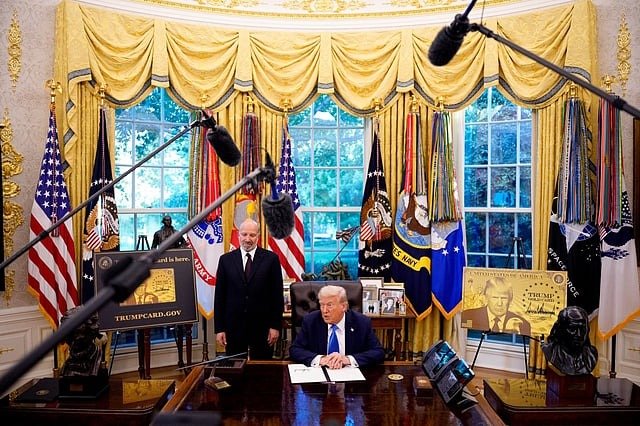
<p><strong>Washington, DC (September 20, 2025)</strong> – US President Donald Trump has announced sweeping changes to America’s skilled immigration system, unveiling two controversial executive orders that could significantly impact global talent mobility and the technology sector.</p><p>The first order introduces a <strong>mandatory $100,000 annual fee</strong> for companies sponsoring workers on H-1B visas, a program widely used to bring in highly skilled foreign professionals such as engineers, scientists, and IT specialists. The second order establishes the <strong>“Trump Gold Card”</strong>, an expedited residency pathway for individuals willing to invest <strong>$1 million personally</strong> or through <strong>$2 million in corporate sponsorships</strong>.</p><p>Speaking from the Oval Office, flanked by Commerce Secretary Howard Lutnick, Trump said the measures are designed to ensure that only the “best and brightest” enter the United States — but at a price. <i>“The main thing is, we’re going to have great people coming in, and they’re going to be paying,”</i> he declared.</p><h3>H-1B Program Under Pressure</h3><p>The H-1B visa program is central to the American technology workforce. Each year, the US government allocates <strong>85,000 new visas</strong> through a lottery system, with foreign workers allowed an initial three-year stay, extendable to six years.</p><p>Indian nationals dominate the program, making up nearly <strong>75 percent of recipients</strong>, as Indian IT firms and US-based tech giants heavily rely on them to fill critical roles. In 2024 alone, the US approved about <strong>400,000 H-1B visas</strong>, with two-thirds being renewals.</p><p>By introducing a steep $100,000 fee per visa, the Trump administration is making it significantly more expensive for companies to hire foreign professionals. Large tech firms like Google, Microsoft, Amazon, and Meta — already heavily dependent on international workers — are expected to face substantial financial strain.</p><p>Industry leaders, including Elon Musk, have previously warned against curbing H-1B visas, arguing that the United States lacks sufficient homegrown talent to sustain its tech sector. Critics fear the new fee could force companies to scale back on innovation or move more operations abroad.</p><h3>A “Gold Card” for the Wealthy</h3><p>Alongside the H-1B overhaul, Trump launched the <strong>$1 million “Trump Gold Card” residency program</strong>, granting permanent residency to individuals who can pay the amount upfront. Corporations sponsoring foreign talent can alternatively pay <strong>$2 million</strong> for expedited pathways.</p><p>The program is being positioned as a fast-track immigration system designed to attract wealthy investors and top global talent. <i>“I think it’s going to be tremendously successful,”</i> Trump said, predicting high demand from wealthy entrepreneurs and skilled professionals seeking a secure future in the US.</p><h3>Mixed Reactions</h3><p>The move has drawn sharp criticism from immigration advocates, tech entrepreneurs, and labor experts. They argue that the steep H-1B fee risks shrinking America’s talent pool, harming competitiveness, and disproportionately impacting Indian and Asian professionals.</p><p><i>“This is essentially pricing out skilled workers and prioritizing wealth over merit,”</i> said one immigration analyst. Critics warn that small and mid-sized businesses may no longer afford to sponsor foreign workers, further consolidating opportunities within big corporations.</p><p>On the other hand, Trump’s supporters view the measures as a way to ensure that America benefits financially from immigration. Commerce Secretary Lutnick said, <i>“All the big companies are on board,”</i> suggesting that major firms are prepared to comply despite the heavy costs.</p><h3>Historical Context</h3><p>Trump has targeted the H-1B program since his first term in office, previously attempting to narrow the types of jobs that qualified for sponsorship. However, earlier efforts faced legal pushback. The new approach, centered on fees rather than eligibility, may be harder to challenge in court.</p><p>This contrasts sharply with the policies of President Joe Biden, under whom H-1B approvals peaked in 2022. Trump’s earlier presidency saw record-high rejections in 2018, highlighting how immigration policies shift drastically depending on the administration.</p><h3>What Lies Ahead</h3><p>The new H-1B fee is set to take effect immediately, though the Homeland Security secretary will have authority to grant exemptions for individuals, companies, or even entire industries. The order is valid for one year but can be extended at Trump’s discretion.</p><p>If fully enforced, the measure could reshape the global flow of talent, pushing companies to reconsider hiring strategies and prompting skilled workers to explore opportunities in other countries such as Canada, Australia, and the UK, which are actively courting tech professionals.</p><p>Meanwhile, the Trump Gold Card program introduces a new model of immigration: wealth-driven pathways to residency. While it may attract high-net-worth individuals, critics argue that it undermines the principle of merit-based entry by turning residency into a privilege for the rich.</p><h3>Conclusion</h3><p>Trump’s latest immigration orders signal a new phase of restriction combined with monetization. By simultaneously making skilled visas more expensive and offering residency for cash, the administration is reshaping America’s approach to foreign talent.</p><p>For the tech industry and global professionals — especially in India — these changes could prove costly and transformative, potentially altering the very future of skilled immigration to the United States.</p>