

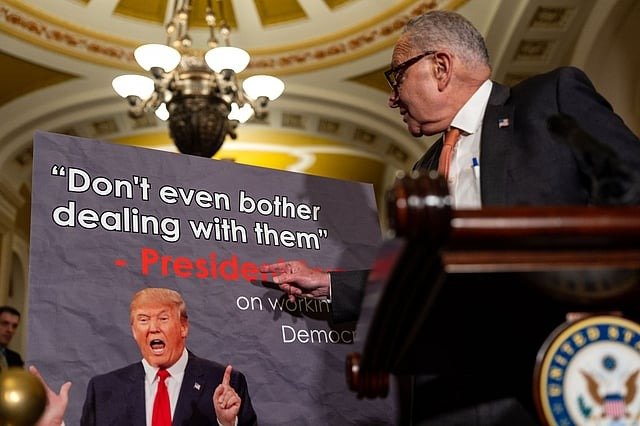
Trump Signals Willingness to Work With Democrats on Health Care — After Ending Shutdown
Washington, D.C.: U.S. President Donald Trump said Monday he would be “happy” to negotiate health care reforms with Democrats — but only once the federal government is reopened, as the ongoing shutdown entered its second week and began to affect essential public services.
The impasse stems from a bitter standoff between Republicans and Democrats over expiring health care subsidies and the future of Trump’s “One Big Beautiful Bill”, which Democrats say has gutted key medical programs. The President’s latest comments signal a willingness to discuss health care policy — but only after Democrats agree to fund the government.
“I am happy to work with the Democrats on their Failed Healthcare Policies, or anything else,” Trump wrote on Truth Social, “but first they must allow our Government to re-open.”
Shutdown Deepens as Congress Remains Deadlocked
The U.S. federal government has been out of funds since Wednesday, after Senate Democrats blocked a House-passed temporary funding bill for the fifth time on Monday evening.
Democrats insist that any short-term budget extension must include provisions to extend “Obamacare” subsidies and reverse recent cuts to health care programs for low-income families. Republicans, however, argue that health care and funding are separate issues that should be addressed independently.
House Speaker Mike Johnson has urged fellow Republicans to stand firm, telling lawmakers not to reconvene until Democrats agree to reopen the government without conditions. “Any debate on health care can come after funding is restored,” Johnson reportedly told his caucus.
Mounting Economic and Social Strain
As the shutdown continues, federal workers are bracing for missed paychecks and service disruptions. Salaries for hundreds of thousands of government employees are expected to be withheld by Friday, while military personnel could go unpaid after October 15 if the deadlock persists.
Non-essential government services, including those at the Environmental Protection Agency (EPA), NASA, and the Departments of Education, Commerce, and Labor, have been heavily affected, with thousands of employees placed on unpaid furlough.
Meanwhile, departments deemed essential — such as Homeland Security, Justice, and Veterans Affairs — continue operating under contingency plans, though experts warn that a prolonged shutdown could still disrupt national operations.
Health Care at the Center of Political Clash
At the heart of the dispute lies a major policy battle over health care access and costs. The Congressional Budget Office (CBO) recently estimated that Trump’s “One Big Beautiful Bill,” enacted on July 4, would strip health coverage from 11 million Americans, mainly due to Medicaid cuts targeting low-income families.
Democrats warn that without renewing Obamacare subsidies, another four million Americans could lose coverage next year, while 24 million might face sharp premium increases.
“Every day this shutdown continues, more American families face uncertainty about their health and finances,” said Senate Minority Leader Chuck Schumer, challenging Republicans to begin health care negotiations immediately.
“If President Trump is serious about lowering health care costs, why wait?” Schumer asked on X (formerly Twitter). “Democrats are ready to do it now.”
Republicans, however, maintain that Democrats are “holding the government hostage” over a partisan demand. “Health subsidies have nothing to do with funding the federal government,” a senior GOP lawmaker said, accusing Democrats of “political theater at the expense of federal workers.”
Public Frustration and Political Fallout
With Congress in recess and no formal talks underway, the shutdown’s political fallout is growing. A CBS News poll released Sunday showed that a narrow majority of Americans blame Republicans for the gridlock, though frustration with both parties remains high.
The White House National Economic Council director, Kevin Hassett, warned that layoffs could escalate if negotiations fail. “The president will not tolerate endless obstruction,” Hassett said. “If there’s no movement, agencies will begin permanent workforce reductions.”
Even before the shutdown, Trump’s administration had already cut 200,000 federal jobs, spearheaded by billionaire Elon Musk’s Department of Government Efficiency (DOGE) — part of a broader effort to streamline government operations.
Path Forward
While Trump’s statement hints at a possible compromise, analysts note that the President’s insistence on reopening the government first could prolong the crisis. Markets have begun showing signs of nervousness, and economic experts warn that a prolonged shutdown could slow growth and shake public confidence.
For now, both sides remain entrenched. Democrats say they will not approve a “clean” funding bill without guarantees on health care protections, while Republicans demand the government be reopened immediately — setting the stage for another tense week in Washington.
Short Summary:
President Trump has expressed readiness to collaborate with Democrats on health care policy — but only after the U.S. government reopens. As the shutdown drags into its second week, millions of Americans face uncertainty over wages, public services, and health coverage amid deep political divisions in Congress.