

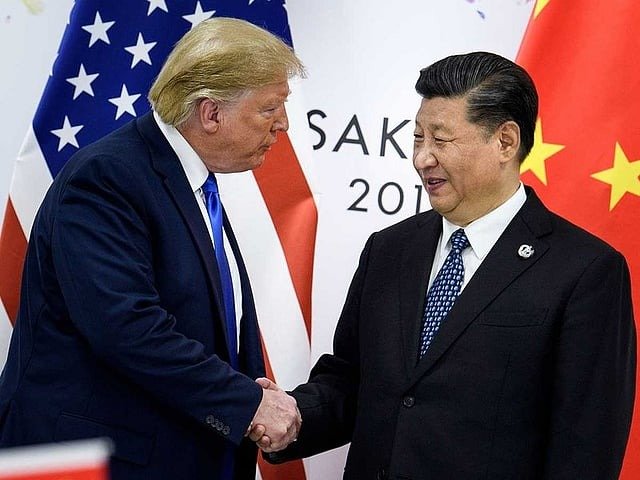
Trump to meet Xi in South Korea amid tensions over trade, North Korea
Trump heads to Asia for high-stakes talks with Xi — North Korea, trade in focus
Washington: US President Donald Trump is embarking on a major diplomatic tour across Asia, culminating in a crucial meeting with Chinese President Xi Jinping on October 30 in South Korea, the White House confirmed on Thursday. The meeting, taking place on the sidelines of the Asia-Pacific Economic Cooperation (APEC) summit, could shape the next chapter of US-China relations and the broader regional balance.
The White House press secretary Karoline Leavitt said, “On Thursday morning local time, President Trump will participate in a bilateral meeting with President Xi of the People’s Republic of China.” The two leaders will meet in Busan, a day before the official start of the APEC summit, scheduled from October 31 to November 1.
Asia tour with global implications
Trump’s trip will begin in Malaysia, followed by stops in Japan and South Korea. It marks his first official visit to Asia since returning to the White House, and his team describes it as a “strategic mission” to strengthen economic and security partnerships across the Indo-Pacific.
The visit comes amid renewed trade tensions between Washington and Beijing, North Korea’s missile provocations, and the ongoing Ukraine war, all of which have placed the region at the center of global geopolitics.
Trump has publicly oscillated between confrontation and diplomacy toward Beijing — threatening to cancel the Xi meeting at one point, before confirming it and declaring he hopes for a “deal on everything.”
Malaysia and Japan stops
Trump departs Washington on Friday, arriving in Malaysia on Sunday for the ASEAN summit — a forum he skipped multiple times in his first term. The US president is expected to oversee the signing of a peace accord between Thailand and Cambodia, a diplomatic move analysts say could bolster his legacy ambitions, including his long-expressed hope for a Nobel Peace Prize.
Malaysian Prime Minister Anwar Ibrahim confirmed that Trump will also ink a bilateral trade deal during his visit. Reports suggest he may meet Brazilian President Luiz Inácio Lula da Silva on the sidelines to mend strained ties.
Trump will then fly to Tokyo, where he will meet Japan’s new Prime Minister Sanae Takaichi — the country’s first female leader — on Tuesday. Japan, which largely escaped the heaviest US tariffs during Trump’s trade crackdowns, is expected to discuss security cooperation and semiconductor supply chains.
South Korea: the climax of the trip
Trump’s final stop, South Korea, promises to be the most consequential. Landing in Busan on Wednesday, he will meet President Lee Jae Myung, address business leaders at an APEC luncheon, and host a dinner with US tech executives in Gyeongju.
The highly anticipated Trump–Xi summit on October 30 will mark their first face-to-face meeting since Trump’s return to office, following months of escalating tariff battles and diplomatic friction.
Global markets are watching closely to see whether the two leaders can ease trade tensions and revive economic cooperation, especially amid Beijing’s rare earth export curbs — a major flashpoint in global supply chains.
Trump also indicated he hopes Xi could play a “big influence” in persuading Russian President Vladimir Putin to end the Ukraine conflict, though few expect significant breakthroughs.
North Korea back in focus
Amid the diplomatic fanfare, North Korea looms large. The regime fired multiple ballistic missiles just days before Trump’s arrival, raising concerns of renewed instability on the peninsula.
South Korean officials confirmed that tours in parts of the Demilitarized Zone (DMZ) have been suspended — fueling speculation of a possible Trump–Kim Jong Un encounter, though the White House has not confirmed any plans.
During his first term, Trump made history by meeting Kim at the DMZ in 2019 — the first sitting US president to do so. He has since said he would “welcome another meeting” if it could advance peace talks.
Analysts temper expectations
Experts caution that the Trump–Xi meeting is unlikely to produce major policy shifts. “This meeting will be a data point along an existing continuum rather than an inflection point,” said Ryan Hass, senior fellow at the Brookings Institution.
Still, the symbolism of two of the world’s most powerful leaders meeting in South Korea — with trade, technology, and nuclear tensions at stake — underscores how the Indo-Pacific region remains the focal point of 21st-century geopolitics.
South Korea, eager to strengthen ties with Washington, is reportedly considering awarding Trump the Grand Order of Mugunghwa, its highest national honor, during his visit.
As Trump embarks on this high-stakes tour, his administration faces the delicate task of balancing assertive diplomacy with strategic restraint — a hallmark of his unpredictable foreign policy style.