
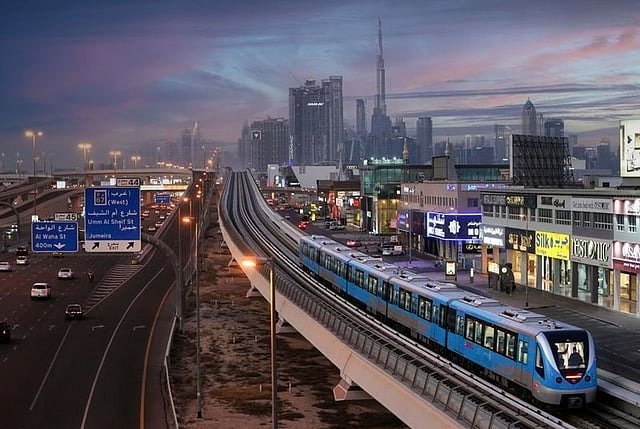
Dubai Metro’s Third Route Launched to Ease Peak-Hour Rush
<h3>Dubai Metro Introduces Third Red Line Route to Ease Peak-Hour Congestion</h3><p><strong>Dubai, UAE</strong> – Sixteen years after launching its iconic transport network, the <strong>Dubai Metro</strong> has taken another major step in enhancing commuter convenience. The <strong>Roads and Transport Authority (RTA)</strong> has introduced a <strong>third route on the Red Line</strong>, aimed at reducing crowding, shortening waiting times, and providing smoother journeys during peak hours.</p><p><strong>Tackling Rush-Hour Pressure</strong><br>The Red Line remains the busiest corridor in the Dubai Metro network, carrying tens of thousands of passengers daily. To address overcrowding, the RTA launched a <strong>peak-only service</strong> running between <strong>Centrepoint station (formerly Rashidiya)</strong> and <strong>Al Fardan Exchange station (formerly Al Khail)</strong>. This service operates during high-demand hours:</p><p><strong>Morning:</strong> 7:00 am – 9:00 am</p><p><strong>Evening:</strong> 4:00 pm – 7:00 pm</p><p>By focusing on these critical periods, the new route ensures faster boarding and less platform congestion for office-goers, students, and regular commuters.</p><p><strong>More Trains, Shorter Waits</strong><br>The introduction of the third route has significantly improved train frequencies along the Red Line:</p><p><strong>Centrepoint – Al Fardan Exchange:</strong> every 2 minutes</p><p><strong>Al Fardan Exchange – National Paints (formerly Jebel Ali):</strong> every 4 minutes</p><p><strong>National Paints – Expo 2020 / Life Pharmacy (formerly UAE Exchange):</strong> every 8 minutes</p><p>These upgrades translate to <strong>quicker, more comfortable journeys</strong>, reducing stress for daily passengers.</p><p><strong>Capacity Boosted by 12%</strong><br>According to RTA officials, the third route has <strong>increased the overall Red Line capacity by 12%</strong>, allowing the network to accommodate more passengers without compromising service quality. Strategically redistributing passenger flow helps keep heavily congested stations like Centrepoint and Al Fardan Exchange manageable during peak periods.</p><p><strong>Supporting Sustainable Travel</strong><br>The Dubai Metro is central to the city’s vision for <strong>eco-friendly, modern, and people-centric transport</strong>. By encouraging public transport usage over private cars, the RTA aims to <strong>reduce road congestion, lower emissions, and promote sustainable urban living</strong>.</p><p><strong>Commuters Praise the Initiative</strong><br>Passengers have already noticed improvements. Mohammed Ali, traveling from Rashidiya to Business Bay, said: <i>“Earlier, mornings were stressful with long queues, but the extra trains now make commuting much smoother.”</i> Aisha Khan, a university student, added: <i>“Even if I miss a train, the next one comes quickly, saving time and reducing frustration.”</i></p><p><strong>Looking Ahead</strong><br>The third Red Line route is part of Dubai Metro’s ongoing evolution. With future expansions, including extensions of the Blue Line, the Metro aims to <strong>connect more communities and serve a growing population</strong>, reflecting Dubai’s strategy to build a <strong>world-class, efficient transport system</strong>.</p><p><strong>Final Thoughts</strong><br>By increasing train frequencies, reducing wait times, and boosting capacity, the RTA has delivered a practical solution to peak-hour congestion. Sixteen years after its launch, the Dubai Metro continues to be a <strong>lifeline for millions</strong>, embodying the city’s spirit of <strong>innovation, efficiency, and sustainability</strong>.</p>