

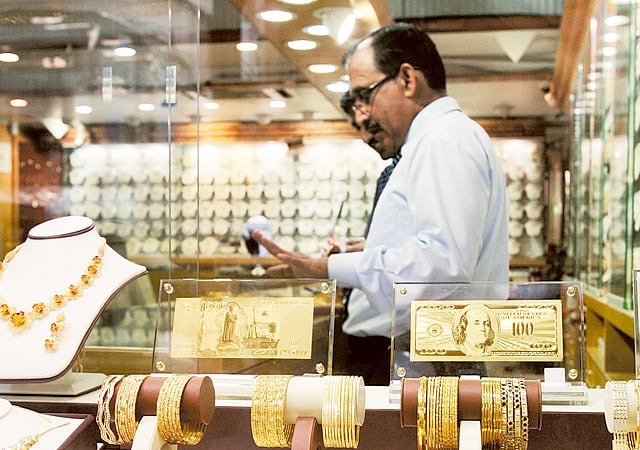
Dubai Gold Prices Cool After Early November Volatility
Dubai’s gold market, known globally for its competitive pricing and high trading volume, has entered a more stable phase after a turbulent beginning to November. Despite fluctuations in international bullion prices and shifting expectations around US monetary policy, local retail rates have narrowed into a tight band, offering buyers and traders a more predictable environment than earlier in the month.
A Tight Trading Range Despite Global Swings
At the start of November, 24K gold in Dubai opened at Dh482.25 per gram. Since then, prices have largely moved within a range of Dh475 to Dh505, reflecting global volatility rather than any major change in UAE-specific demand.
On November 4, 24K gold hit its lowest point of the month at Dh475.25, driven by a stronger US dollar and a dip in international gold prices. Shortly afterward, global markets saw a renewed demand for safe-haven assets as uncertainty grew around the Federal Reserve’s next interest-rate decision, pushing Dubai’s retail price back up to Dh504.75 by November 12.
From mid-November, the market began cooling again. Prices slipped into the high Dh480s, eventually stabilising at Dh489.75 on November 18 and 19, where they continue to hold steady.
As the world’s second-largest gold trading hub, the UAE imports large volumes of gold from all continents, meaning local prices closely track global trends rather than domestic buying patterns.
Three Clear Price Phases in November
The movement of 24K gold this month can be broken down into three distinct phases:
Phase 1: A Wobbly Start (Nov 1–4)
Started at Dh482.25
Declined to Dh475.25 by November 4
Driven by a strong dollar and weak global bullion sentiment
Phase 2: A Short Rally (Nov 5–13)
Recovered to Dh495.50 by November 11
Peaked at Dh504.75 on November 12
Boosted by safe-haven demand and a brief pause in dollar strength
Phase 3: Cooling and Stabilisation (Mid-Nov Onward)
Settled between Dh485 and Dh493
Traders turned cautious, awaiting more clarity on December rate-cut chances
A nearly identical pattern played out in 22K gold. Prices opened at Dh446.50, dipped to Dh440 on November 4, climbed to Dh467 on November 12, then eased back to the mid-450s, where they now hover around Dh453.50.
This parallel movement across purity levels shows how closely the UAE’s gold pricing follows global macroeconomic signals.
International Bullion: Recovery After Earlier Losses
Global gold prices have shown signs of strength after recovering from a recent fall. International bullion is now trading around $4,109 per ounce, after a 0.3% rise in the previous session. Analysts say demand remains firm, even though wider financial markets have adopted a more risk-on tone.
The resurgence of global equity markets — particularly major technology stocks driven by Nvidia’s strong earnings forecast — has created a surprising link between AI-heavy portfolios and gold prices. This correlation has become more noticeable in 2025, with investors balancing tech-driven optimism with the safety of precious metals.
Rate Expectations Continue to Guide Market Sentiment
The Federal Reserve remains a key influence on both international and Dubai gold prices. With US policymakers maintaining a data-dependent approach, traders across the UAE are cautiously reassessing how likely a December interest-rate cut may be.
Until the Fed sends clearer signals, most analysts expect Dubai’s gold prices to:
Remain in a tight corridor
Experience quick intraday swings
Mirror global momentum rather than respond to local retail demand
For now, the range-bound nature of Dubai’s gold market reflects a temporary calm as investors, retailers, and traders all wait for the next major policy announcement.
A Market Defined by Global Forces
As the UAE continues to cement its status as one of the world’s top gold trading hubs, local pricing remains highly sensitive to macroeconomic trends. A strengthening dollar, Fed policy speculation, shifts in equity markets, and global geopolitical changes all contribute to the real-time movements that shape Dubai’s gold rates.
While the early part of November brought significant volatility, the latter half has delivered a more stable trading environment — at least for now. Whether this calm holds will depend on upcoming economic data and central bank statements that have the power to move global bullion markets once again.