

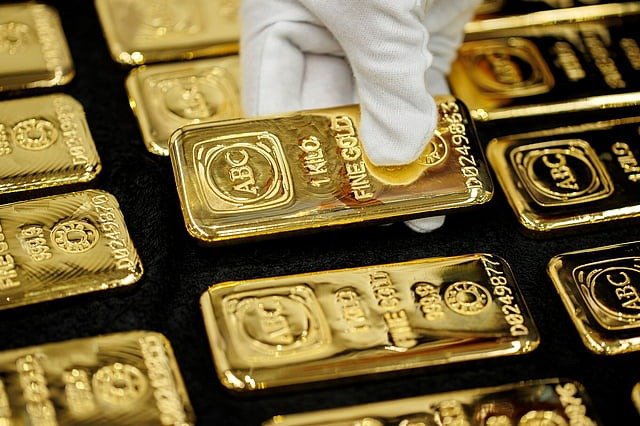
Gold Prices Hold Near $4,000 as Market Finds Support
<h3><strong>Gold Prices Steady Near $4,000 as Buyers Watch for Market Floor</strong></h3><p>Gold is holding its ground just above the <strong>$4,000 per ounce mark</strong>, signaling a potential period of consolidation after months of dramatic gains. Investors and traders are closely watching whether this level will form a <strong>solid price floor</strong>, providing a new base for the next leg higher. While short-term volatility remains, analysts believe the market’s broader uptrend is still intact — and gold’s long-term appeal as a safe-haven asset remains strong.</p><h4><strong>After the Rally, a Cooling Phase</strong></h4><p>The metal ended the week at <strong>$4,011 per ounce</strong>, down <strong>2.3%</strong> from last week’s close, but still an impressive <strong>54% higher year-to-date</strong>. The pullback comes after October’s sharp rally, which many analysts viewed as overheated. According to the <strong>World Gold Council</strong>, the current price movement looks more like a <strong>pause for consolidation</strong> than a reversal in trend.</p><p>The Council stated that gold “appears to have entered a consolidation phase to unwind the historical overbought condition — a healthy development within the core uptrend.” In other words, gold is taking a breather, not losing momentum.</p><h4><strong>Key Support and Resistance Levels</strong></h4><p>Technical traders are eyeing key support around <strong>$3,777 to $3,729</strong>. As long as prices hold above that zone, confidence in a stable floor will strengthen. On the other hand, a breakout above <strong>$4,158 to $4,162</strong> could signal that gold is ready to resume its upward march toward new highs.</p><p>So far, trading activity suggests the market is <strong>catching its breath</strong> rather than exiting. Exchange-traded gold funds (ETFs) have seen modest outflows, indicating some profit-taking, while <strong>options traders have reduced their bullish positions</strong> after an extended rally. Despite this, the market’s volatility — though still high — appears to be easing, suggesting a steadier trading environment ahead.</p><h4><strong>Macroeconomic and Political Factors at Play</strong></h4><p>The global economic backdrop remains a major influence on gold prices. The <strong>US government shutdown</strong> has limited key data releases, forcing investors to rely on <strong>private economic surveys and Federal Reserve commentary</strong> for direction. Meanwhile, ongoing <strong>budget disputes and state-level elections</strong> in the US are adding layers of political uncertainty that tend to keep safe-haven demand alive.</p><p>Betting markets currently see <strong>little chance of a quick resolution</strong> to the US funding impasse, further reinforcing gold’s defensive appeal. When political risk is high and financial data is scarce, gold often benefits from its reputation as a stable store of value.</p><h4><strong>Strong Global Demand Supports the Market</strong></h4><p>Fundamentally, <strong>global demand for gold remains solid</strong>. In the third quarter of 2025, total demand — including over-the-counter (OTC) transactions — reached <strong>1,313 tonnes</strong>, up <strong>3% year-on-year</strong>. This made it one of the strongest quarters on record for both demand and average prices. The <strong>World Gold Council</strong> highlighted that investment demand was strong enough to <strong>offset weaker demand from jewelry fabrication</strong>, especially in markets like India and China.</p><p>In the UAE and across the Gulf, <strong>retail demand remains firm</strong> as consumers continue to view gold as a reliable investment and inflation hedge. Dubai’s gold market, known for competitive pricing and tax advantages, continues to attract global buyers, even as global spot prices fluctuate.</p><h4><strong>What Should Buyers Do Now?</strong></h4><p>For potential buyers considering an entry this week, experts advise <strong>patience rather than urgency</strong>. The current range between $3,750 and $4,150 represents a <strong>stabilization phase</strong>, not necessarily a breakout or breakdown. Entering the market during consolidation can be risky unless clearer signals emerge — such as a confirmed support level or a rebound in global economic confidence.</p><p>Analysts note that <strong>a firmer floor and more stable macroeconomic data</strong> could provide a cleaner buying opportunity. For now, the gold market seems to be digesting its massive gains while waiting for the next catalyst, whether it’s geopolitical tension, interest rate changes, or economic data surprises.</p><h4><strong>Outlook: Gold Still Holds Its Shine</strong></h4><p>Despite the recent dip, gold’s <strong>long-term outlook remains bullish</strong>. Persistent <strong>geopolitical risks, elevated bond market volatility, and uncertain global growth</strong> all continue to support demand for safe-haven assets. Even as traders take profits and short-term volatility eases, the broader uptrend appears <strong>far from over</strong>.</p><p>As the market steadies near $4,000, investors are watching closely for confirmation of a new price base. If support holds and macro conditions remain uncertain, gold could soon attempt another push higher — reaffirming its role as one of the world’s most trusted stores of value.</p>