

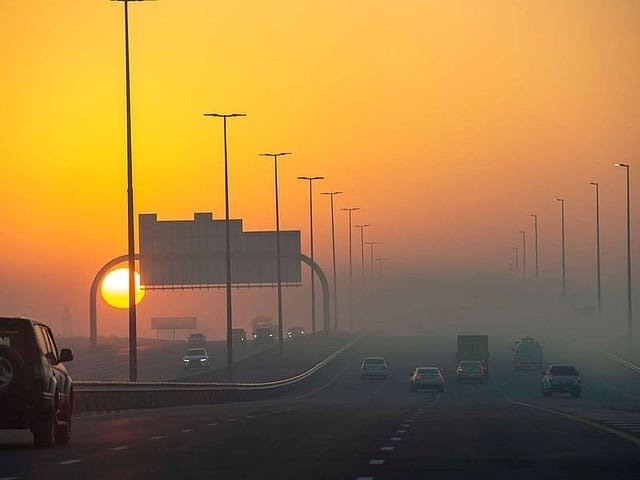
Why UAE Mornings Turn Foggy and Humid as Summer Ends
<p>As the UAE bids farewell to the long summer heat, residents often find themselves waking up to <strong>dense blankets of fog and rising humidity</strong> that dominate the early morning hours. From about <strong>2 am until 9 am</strong>, thick, swirling fog obscures the skyline, slows traffic, and creates dramatic sunrises across the Emirates.</p><p>While many assume fog is a quirk of the desert climate, it is actually a <strong>scientifically predictable outcome</strong> of the UAE’s unique geography and seasonal weather patterns. The end of summer marks a transitional period where hot desert air, cooling seas, and high humidity interact in ways that produce this striking natural phenomenon.</p><h3>The Coastal Clash: Sea Breeze vs. Desert Heat</h3><p>The UAE’s foggy mornings are largely the result of a <strong>battle between desert heat and sea air.</strong></p><p><strong>Sea influence:</strong> By late September and October, the air drifting inland from the <strong>Arabian Sea</strong> is noticeably cooler than the lingering heat stored in the desert sands.</p><p><strong>Desert influence:</strong> Throughout the day, the land absorbs high levels of solar energy. After sunset, this heat radiates back into the atmosphere overnight, producing <strong>pockets of warm rising air.</strong></p><p>When this warm desert air collides with cooler, moisture-laden sea breezes, <strong>condensation occurs.</strong> The water vapor in the air transforms into tiny droplets, producing the fog that hovers across highways, open fields, and coastal zones.</p><p>Think of it like walking out of an air-conditioned building with glasses on: they instantly fog up when warm, humid air touches a cooler surface. The UAE atmosphere experiences a similar process—only on a much larger scale.</p><h3>Humidity: The Invisible Factor</h3><p>Another major contributor is <strong>humidity.</strong> During these transitional months, moisture levels in the air can soar up to <strong>90 percent</strong>, especially near dawn.</p><p>High humidity mixes with suspended particles like <strong>fine sand and silica dust</strong> carried inland by light winds. This combination helps form fog that appears denser and lingers for longer, sometimes well past sunrise.</p><p>It isn’t until the sun’s rays grow strong—typically after 8 am—that the atmosphere warms enough to evaporate the moisture and restore visibility.</p><h3>Radiation Fog and the Cooling Sea</h3><p>Meteorologists also point to a second process: <strong>thermal radiation fog.</strong></p><p>At night, the <strong>Arabian Sea cools rapidly</strong>, lowering the air’s capacity to hold moisture. This leads to condensation and fog formation over coastal areas. Unlike the sea breeze interaction, this type of fog occurs because of the <strong>air cooling directly at the surface</strong>.</p><p>Interestingly, fog isn’t limited to the coasts. In the country’s interior deserts, overnight cooling also triggers fog formation. Inland fog can often be <strong>thicker and more persistent</strong>, because land surfaces take longer to warm than coastal waters.</p><h3>Why Now? The Seasonal Transition</h3><p>Fog at this time of year is part of the UAE’s <strong>climate transition</strong> from summer to winter.</p><p><strong>September to November:</strong> Transitional fog, often patchy and linked to desert-sea interactions.</p><p><strong>December to March:</strong> Peak fog season, with the <strong>thickest and longest-lasting fogs</strong> as cool winter air dominates.</p><p>So, while October mornings may feel unusually damp and hazy, this is just a <strong>precursor to the heavier fogs of mid-winter.</strong></p><h3>Safety and Daily Life Impact</h3><p>While fog paints beautiful landscapes, it also disrupts daily routines. Reduced visibility leads to <strong>slower commutes, flight delays, and road accidents.</strong> Authorities like the <strong>UAE’s National Centre of Meteorology (NCM)</strong> issue frequent fog alerts, urging drivers to reduce speed, keep headlights on low beam, and maintain safe distances during early-morning travel.</p><h3>A Distinct Desert Phenomenon</h3><p>Fog is not uncommon worldwide, but the UAE’s blend of <strong>desert geography, coastal waters, and extreme summer-to-winter contrasts</strong> makes it particularly distinctive. The fog here is often denser and more widespread than in many other regions, covering highways and even stretching across entire emirates.</p><h3>Looking Ahead</h3><p>Meteorologists note that while foggy mornings begin in September and October, the <strong>“foggiest days” are yet to come.</strong> From <strong>mid-December to March</strong>, visibility can plunge to just a few meters for hours at a time. Until then, residents can expect <strong>humid, misty mornings</strong> as the region fully transitions out of summer.</p><p>In essence, the UAE’s morning fog is more than just weather—it is a <strong>marker of seasonal change</strong>, a reminder of how desert heat, sea air, and humidity interact in remarkable ways as the country shifts toward its cooler months.</p>