
Desert Magic: UAE’s Hidden Wildlife Through an Artist’s Lens
Desert Magic: UAE’s Hidden Wildlife Through an Artist’s Lens
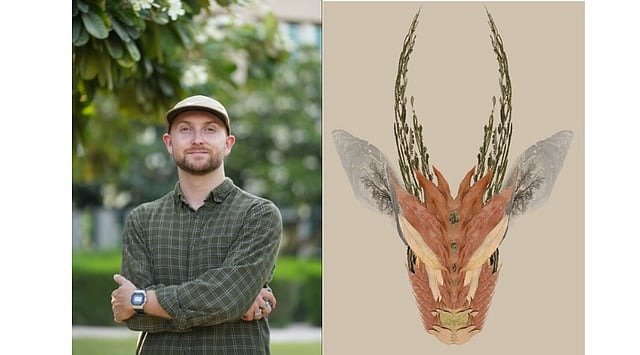
“The greatest secrets are always hidden in the most unlikely places,” wrote Roald Dahl—and nowhere does this feel truer than in the deserts of the United Arab Emirates. Amidst its endless dunes and rugged mountains, an artist and environmentalist named Miles Critchley-Hope has uncovered stories of resilience, survival, and beauty—told through the eyes of the creatures that inhabit this harsh yet enchanting landscape.
Miles, a postgraduate student at Sorbonne University Abu Dhabi, combines art, ecology, and photography in his project Symbiosis, a visual tribute to the UAE’s native wildlife. His journey from the lush greenery of Somerset, UK, to the golden expanse of the Arabian desert reflects his lifelong fascination with nature. “I grew up surrounded by fields and forests,” he says, “and that connection to the outdoors has always shaped how I see the world.”
In 2024, that curiosity brought him to the UAE, where he began studying animals that most people rarely see outside documentaries or desert safaris. His work captures creatures such as the Arabian gazelle, black fat-tailed scorpion, Arabian oryx, spiny-tailed lizard (dhub), collared kingfisher, Gyr falcon, and Arabian horned viper. Each animal, he explains, embodies a distinct personality and purpose in the desert ecosystem.
Take the spiny-tailed lizard, for example—a species that can live up to 80 years and survive for days without food or water. Miles speaks about it with childlike enthusiasm, describing its resilience and the way it burrows through sand to escape the heat. Even the scorpion, often feared and misunderstood, earns his admiration. “That’s a wicked animal,” he laughs, noting how perfectly adapted it is to the unforgiving environment.
What makes Symbiosis remarkable is its attention to both scientific detail and emotional depth. Miles spent months researching, photographing, and identifying each species. “Finding accurate names for plants and animals—sometimes in both English and Arabic—was challenging,” he says. “But every step helped me understand the richness of this environment.” His photographic collages layer texture, color, and light to create immersive, almost dreamlike portraits of desert life. Each piece underwent several prototypes before reaching perfection.
The collection will be showcased at the IUCN World Conservation Congress in Abu Dhabi, an international platform for environmental dialogue and awareness. For Miles, the exhibition is more than an artistic achievement—it’s a message about coexistence. “I want people to see how extraordinary these animals are,” he explains. “The desert isn’t empty—it’s alive with stories, movement, and connection.”
His education at Sorbonne University played a pivotal role in this project. “Studying sustainable engineering taught me how to plan, manage timelines, and build projects that merge creativity with scientific responsibility,” he says. “And learning environmental law gave me a deeper understanding of how art can support global conservation efforts.”
Through his lens, the barren sands of Liwa and the mountains of Ras Al Khaimah transform into stages where the UAE’s wildlife thrives quietly, undisturbed. Miles hopes his work inspires more appreciation—and protection—for these delicate ecosystems. “Art,” he believes, “has the power to make people feel something real. Once you feel connected to nature, you naturally want to protect it.”
From the shimmering gaze of a gazelle to the intricate armor of a scorpion, Symbiosis reveals the desert’s hidden magic. In every frame, there’s a reminder that wonder still exists—if only we stop long enough to look.
As Miles puts it, “Magic is real—and sometimes, it’s just hiding in the sand.”