

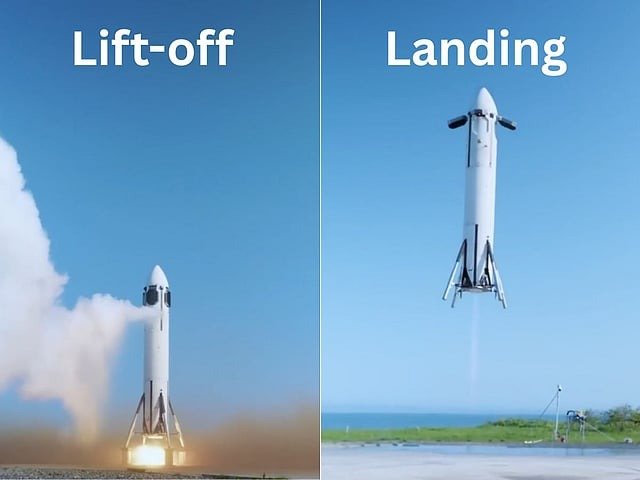
Honda Successfully Tests Reusable Rocket in Japan
<h3><strong>Honda’s Reusable Rocket Test Marks Breakthrough in Aerospace Ambitions</strong></h3><p><strong>Tokyo, Japan:</strong> In a major step toward its space exploration goals, <strong>Honda R&D Co. Ltd</strong> has successfully conducted a <strong>test flight of its experimental reusable rocket</strong>, achieving a precise vertical takeoff and landing in <strong>Taiki Town, Hokkaido</strong>. The rocket reached a <strong>maximum altitude of 271.4 meters</strong> before descending and landing <strong>just 37 centimeters from its intended target</strong> after a flight lasting <strong>56.6 seconds</strong>.</p><p>This successful test is a significant milestone in <strong>Honda’s aerospace development program</strong>, reinforcing the automaker’s expanding vision of “creating mobility beyond Earth.” It also places Honda among a growing list of companies investing in <strong>reusable rocket technology</strong>, seen as the future of affordable and sustainable space access.</p><h3><strong>A Step Forward in Reusable Rocket Development</strong></h3><p>Honda’s reusable rocket project began in <strong>2024</strong>, with a series of <strong>combustion and hovering tests</strong> aimed at developing a vertical landing system that can withstand repeated use. The recent achievement shows tangible progress toward <strong>safe, controlled reentry and landing</strong> — essential elements for <strong>cost-effective space launches</strong>.</p><p>The company said the test marks a “major step toward the practical application of reusable rockets,” aligning with its long-term goal of building a <strong>reliable, low-cost launch system</strong> capable of carrying small satellites into orbit.</p><p>Industry observers note that Honda’s progress in just one year underscores Japan’s increasing participation in the <strong>commercial space race</strong>, long dominated by companies such as <strong>SpaceX</strong> and <strong>Blue Origin</strong>.</p><h3><strong>Why Reusability Is the Future of Spaceflight</strong></h3><p>Reusable rockets have transformed the economics of space exploration. Traditional rockets — used once and discarded — cost <strong>up to $100 million per launch</strong>, creating a financial barrier for private space ventures. In contrast, reusable rockets drastically reduce costs by <strong>recovering and refurbishing major components</strong>, such as engines and first-stage boosters.</p><p>A 2018 <strong>Acta Astronautica</strong> study led by <strong>Pozo et al.</strong> found that <strong>reusable rockets could lower launch costs by 30–50% after 10 flights</strong>, with a breakeven point achieved after just <strong>3–5 reuses</strong>. Even with potential failure rates of up to 5%, their models showed <strong>significant long-term savings</strong> compared to expendable launch systems.</p><p>SpaceX’s <strong>Falcon 9</strong> — the most successful reusable rocket to date — has flown <strong>over 300 missions since 2015</strong>, with some boosters reused <strong>more than 20 times</strong>. The company’s innovations have reduced per-launch costs from roughly <strong>$60 million to below $30 million</strong>, proving the commercial viability of reusability.</p><h3><strong>Global Competition Heats Up</strong></h3><p>Honda’s experiment comes at a time when <strong>international competition in reusable launch vehicles</strong> is intensifying.</p><p><strong>China</strong> is testing the <strong>Long March 8R</strong>, a reusable version of its reliable orbital launcher.</p><p><strong>Europe’s Themis program</strong> is developing a prototype under the <strong>ArianeGroup</strong>, though progress has been slowed by funding cycles.</p><p><strong>Blue Origin’s New Glenn</strong> aims for full-stage reusability but faces challenges recovering upper-stage components.</p><p>Against this backdrop, <strong>Honda’s entry</strong> highlights Japan’s commitment to establishing an independent and innovative presence in <strong>aerospace technology</strong>. The company’s engineering background — from robotics to aviation — gives it a unique foundation for developing advanced <strong>propulsion, guidance, and landing systems</strong>.</p><h3><strong>Economic Impact of Reusable Rockets</strong></h3><p>Reusable launch technology is not just about engineering triumphs — it’s about transforming space economics.</p><p>A <strong>2022 Journal of Spacecraft and Rockets</strong> study by <strong>Zapata et al.</strong> projected that <strong>100+ reuses per rocket</strong> could drive costs below <strong>$5 million per launch</strong>, assuming high recovery rates. With further refinements, rockets may soon operate <strong>more like commercial aircraft</strong>, with rapid turnaround and minimal refurbishment between flights.</p><p>For companies like Honda, this translates into <strong>lower launch costs for satellites</strong>, opening opportunities in <strong>telecommunications, Earth observation, and scientific research</strong>. It also positions Japan to become a <strong>regional launch hub</strong> for small and medium payloads, complementing global efforts to make space more accessible.</p><h3><strong>Honda’s Vision: Mobility Beyond Earth</strong></h3><p>Honda’s aerospace initiative is part of its broader vision to “expand the realm of mobility.” Beyond cars, motorcycles, and jets, the company is exploring how its technologies — such as <strong>AI, robotics, and renewable energy systems</strong> — can contribute to <strong>space exploration and sustainability</strong>.</p><p>In a statement, Honda R&D said, <i>“Our reusable rocket development is not only about reaching space — it’s about creating sustainable, repeatable access to it. We are designing the technology that will make space exploration as reliable as any other form of mobility.”</i></p><p>The successful test in Hokkaido showcases Honda’s <strong>engineering precision and long-term commitment</strong> to entering the aerospace sector. While it remains in early development, the results suggest that <strong>Honda could become a competitive player in commercial launch services</strong> in the coming decade.</p><h3><strong>The Road Ahead</strong></h3><p>Honda plans to conduct <strong>higher-altitude tests</strong> in the coming months, eventually transitioning to <strong>orbital launch trials</strong>. Future goals include developing <strong>multi-engine reusable systems</strong> and exploring <strong>partnerships with Japanese and international space agencies</strong>.</p><p>As <strong>reusable rocket technology</strong> continues to reshape the space industry, Honda’s success adds another powerful contender to the field. While <strong>SpaceX’s Starship</strong> and <strong>Blue Origin’s New Glenn</strong> aim for interplanetary travel, Honda’s approach reflects Japan’s focus on <strong>precision, efficiency, and sustainability</strong> — qualities that could redefine space access for the next generation.</p>