

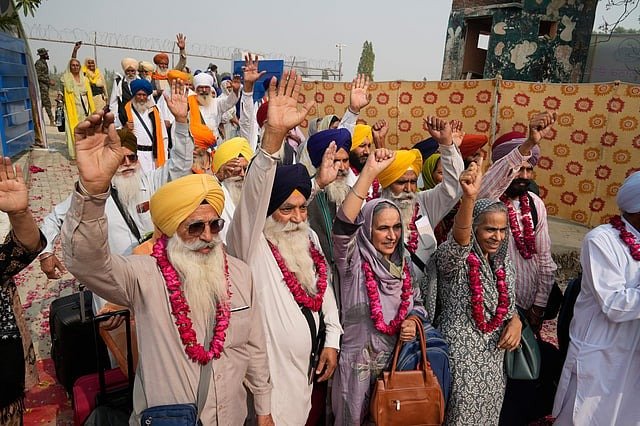
Indian Sikh Pilgrims Enter Pakistan for Guru Nanak Jayanti
<h3><strong>Indian Sikh Pilgrims Cross into Pakistan for Guru Nanak’s Birth Anniversary Celebrations</strong></h3><p><strong>Lahore, November 4, 2025</strong> — In a moment of renewed spiritual connection and cross-border harmony, hundreds of <strong>Indian Sikh pilgrims</strong> entered Pakistan on Tuesday through the <strong>Wagah-Attari border</strong> to participate in the <strong>556th birth anniversary celebrations of Guru Nanak Dev Ji</strong>, the founder of Sikhism.</p><p>The pilgrimage marks the <strong>first major cross-border visit</strong> since tensions between India and Pakistan led to a temporary closure of the route in <strong>May 2025</strong>. The reopening has been widely welcomed by the Sikh community, who view this annual journey as one of deep religious and emotional significance.</p><h4><strong>Warm Welcome at the Wagah Border</strong></h4><p>The pilgrims were greeted by Pakistani officials, members of the <strong>Evacuee Trust Property Board (ETPB)</strong>, and representatives of the <strong>Pakistan Sikh Gurdwara Parbandhak Committee (PSGPC)</strong>, who extended a warm welcome with garlands and traditional hospitality.</p><p>According to the <strong>Pakistan High Commission in New Delhi</strong>, more than <strong>2,100 visas</strong> were issued to Indian Sikhs to attend the <strong>10-day festival</strong>. The celebrations are centered around <strong>Gurdwara Janam Asthan</strong> in <strong>Nankana Sahib</strong>, near Lahore — the sacred birthplace of Guru Nanak Dev Ji — and include visits to other major shrines like <strong>Gurdwara Kartarpur Sahib</strong> and <strong>Gurdwara Dera Sahib</strong>.</p><h4><strong>A Journey of Faith and Brotherhood</strong></h4><p>For many pilgrims, this journey represents not just a religious obligation but also an emotional homecoming. Guru Nanak’s life and teachings continue to serve as a powerful symbol of <strong>unity, peace, and devotion</strong> across borders.</p><p>“This is more than a pilgrimage — it’s a journey of the soul,” said one devotee before crossing into Pakistan. “Being able to walk on the same land where Guru Nanak was born and preached feels like a blessing.”</p><p>As the pilgrims made their way across the <strong>Wagah border</strong>, many waved Indian flags and chanted “<strong>Waheguru Ji Ka Khalsa, Waheguru Ji Ki Fateh</strong>,” expressing joy and gratitude for being granted the opportunity to visit their holy sites after months of uncertainty.</p><h4><strong>Celebrations at Nankana Sahib</strong></h4><p>In <strong>Nankana Sahib</strong>, preparations have been in full swing for weeks. The shrine has been beautifully decorated with <strong>lights, flowers, and religious banners</strong>, and special security and accommodation arrangements have been made to host thousands of devotees from around the world.</p><p>Over the course of the festival, pilgrims will take part in <strong>Akhand Path (continuous reading of the Guru Granth Sahib)</strong>, <strong>Kirtan (devotional singing)</strong>, and <strong>Langar (community meals)</strong> — all of which reflect the Sikh principles of <strong>service, equality, and spiritual devotion</strong>.</p><p>Officials confirmed that both the Pakistani and Indian governments have worked closely to ensure smooth travel logistics and safety measures for all participants.</p><h4><strong>A Step Toward Peace and Understanding</strong></h4><p>The cross-border pilgrimage is being seen as a <strong>positive gesture of goodwill</strong> between India and Pakistan at a time when political relations have often been strained. Religious exchanges like this one, observers say, help <strong>build bridges of cultural understanding</strong> and reinforce shared heritage between the two nations.</p><p>“The Sikh pilgrimage is a reminder that faith can transcend boundaries,” said a representative of the PSGPC. “It keeps alive the message of peace that Guru Nanak preached — a message that is as relevant today as it was five centuries ago.”</p><h4><strong>Deep Spiritual Significance</strong></h4><p>Pakistan’s Punjab province is home to several of <strong>Sikhism’s holiest shrines</strong>, including the <strong>Gurdwara Janam Asthan</strong> in Nankana Sahib, where Guru Nanak was born in 1469, and <strong>Gurdwara Kartarpur Sahib</strong>, where he spent the final years of his life.</p><p>For devotees, visiting these sacred places is considered a <strong>once-in-a-lifetime spiritual experience</strong>. Many pilgrims expressed their gratitude for being able to offer prayers at the birthplace of their spiritual leader.</p><p>“I have dreamed of this day for years,” said a 65-year-old pilgrim from Amritsar. “Crossing the border and touching the soil of Nankana Sahib feels like meeting Guru Nanak himself.”</p><h4><strong>Conclusion</strong></h4><p>As the 10-day celebrations unfold, thousands of Sikhs from across the globe are expected to gather in Pakistan to honor Guru Nanak’s teachings of <strong>love, equality, and compassion</strong>.</p><p>The 2025 pilgrimage stands as a <strong>powerful symbol of faith and fraternity</strong>, reminding both nations of their shared spiritual legacy — and the unifying message of a saint who taught the world that <strong>“there is no Hindu, there is no Muslim — only the human.”</strong></p>