

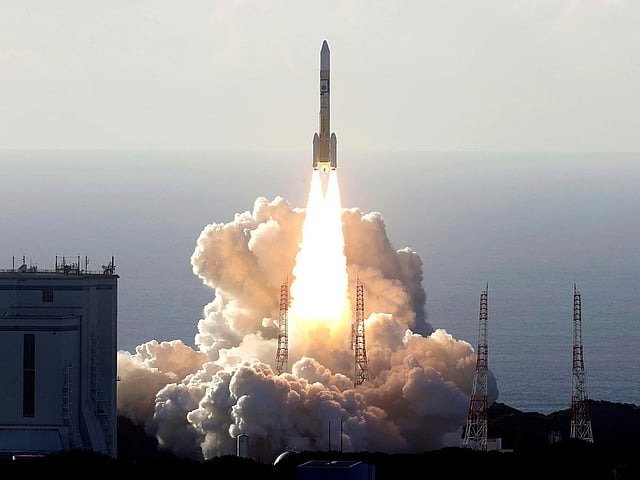
Why the UAE Needs Its Own Orbital Launch Capability
As global competition intensifies in space technology, data infrastructure, and artificial intelligence, the UAE’s long-term economic and strategic priorities increasingly point toward a critical need: developing its own domestic orbital access capability. While only a handful of nations currently possess the means to launch satellites independently, experts argue that for the UAE, this capability is no longer optional—it is becoming a national imperative.
Independent access to outer space has always held immense strategic value. Historically, the only countries capable of launching their own satellites were those with vast economic or military resources. However, today’s world—shaped by rapid technological evolution, the rise of AI, and a global shift toward data-driven economies—has amplified the importance of building sovereign space-launch capacity. For the UAE, a nation deeply committed to technological leadership and digital transformation, this capability would play a pivotal role in safeguarding future growth.
Space: A Strategic and Economic Priority for the Future
Outer space has long been viewed through the lens of exploration and national prestige. But its relevance has expanded dramatically. Modern communications, navigation, climate monitoring, national security, and global data networks rely heavily on orbital infrastructure.
The UAE has achieved remarkable milestones in a short time: launching the Hope Probe to Mars, deploying advanced satellites, sending astronauts to the International Space Station, and developing lunar missions. These achievements demonstrate the nation’s ambition, capability, and commitment to becoming a key player in the global space ecosystem.
But despite its rapid progress, the UAE remains dependent on international launch providers—an arrangement that limits autonomy and adds logistic, financial, and geopolitical uncertainties. Building a domestic launch capability would solve these challenges and elevate the UAE into a select group of nations with direct access to space.
AI, Data Centres, and the Coming Wave of Orbital Infrastructure
Artificial intelligence is reshaping industries, cities, and economies—yet its future depends heavily on satellite systems and data networks. The global surge in demand for data centres, cloud computing, and high-capacity communication networks is creating unprecedented pressure on orbital infrastructure.
AI itself is expected to move into space. Experts predict that within the coming decade, orbiting AI platforms will process vast data streams from Earth, enabling real-time analytics, monitoring, and automation.
This shift reinforces a critical point: nations without sovereign access to space may find themselves strategically disadvantaged in the emerging technological order.
Global Launch Trends Highlight the Urgency
From early 2023 to mid-2025, a total of 625 orbital launches took place worldwide. The vast majority were dominated by:
United States: 58.24%
China: 27.36%
Russia: 6.88%
The remaining launches came from India, Japan, Iran, Israel, South Korea, and select European countries.
Remarkably, only about a dozen countries worldwide have the capability to place satellites in orbit. Importantly, economic size alone does not determine this capability. For example:
The UK (GDP $3.6 trillion) has no independent orbital launch capability.
The UAE (GDP $552 billion) also lacks such access.
But countries with smaller economies—including Iran, Israel, and South Korea—have successfully built their own launch systems.
This demonstrates that national will, investment, and strategic focus—not GDP size—are the deciding factors.
The Global Launch Industry Is Expanding Fast
The 625 launches sent 7,894 spacecraft into orbit, with a total payload mass of nearly 5 million kilograms. Much of this growth has been driven by private-sector giants such as SpaceX, CASC, Roscosmos, Rocket Lab, and ULA.
As competition intensifies and satellite deployment accelerates, access to launch windows may become increasingly constrained. Nations without their own systems risk delays, higher costs, and reduced strategic autonomy.
The UAE’s Growing Space Leadership
The UAE’s National Space Strategy (2019) and the National Space Fund (2022) positioned space as a core pillar of the nation’s future. The establishment of the UAE Supreme Space Council in October 2024 further reinforced this commitment. UAE space institutions—including the UAE Space Agency and the Mohammed bin Rashid Space Centre—have made tremendous progress.
Yet one essential objective has yet to be formally declared: building a domestic orbital launch system.
This capability could be pursued through:
Traditional rockets
Reusable launch vehicles
Future technologies such as space elevators or hybrid systems
Regardless of the method, the benefits would be enormous—enhancing national resilience, technological sovereignty, economic growth, and global competitiveness.
A Strategic Vision for the Next Century
For the UAE, direct access to outer space is not just about launching satellites—it is about securing long-term digital, economic, and strategic independence. As AI expands, data becomes the world’s most valuable resource, and space systems form the backbone of modern economies, orbital access becomes as essential as energy, ports, or national telecom networks.
The UAE has already proven its ability to aim high—and achieve even higher. Building domestic orbital launch capability is the next frontier, and it is essential for ensuring the country’s future relevance, reach, and resilience in the global space economy.