

UAE ‘Probably’ Won’t Join Gaza Stabilisation Force: Gargash
UAE Unlikely to Join Gaza Stabilisation Force, Says Dr. Anwar Gargash
Dubai: The United Arab Emirates is not planning to join the proposed international stabilisation force for Gaza, citing the lack of a clear and agreed framework for its operations, according to Dr. Anwar Gargash, diplomatic adviser to the UAE President.
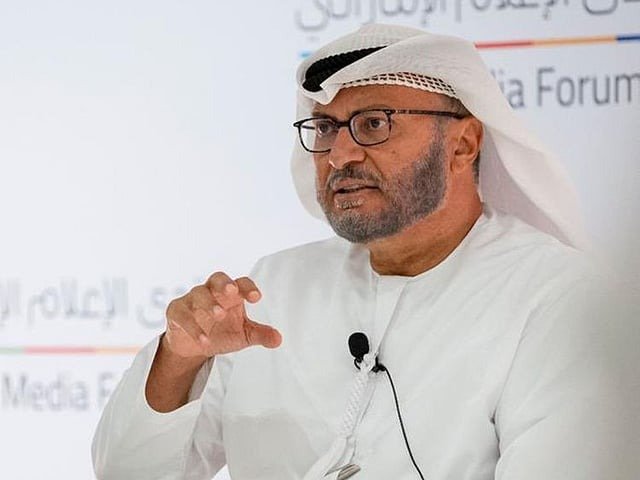
Speaking at the Abu Dhabi Strategic Debate forum, Dr. Gargash stated:
“The UAE does not yet see a clear framework for the stability force, and under such circumstances, it will probably not participate in such a force.”
The remarks clarify the UAE’s position amid growing international discussions over a US-led proposal to deploy a multinational force to stabilise Gaza following years of conflict. The proposed mission would reportedly involve participation from Egypt, Qatar, and Turkey, though details about its structure and mandate remain unsettled.
Awaiting a Defined Framework
The idea of a Gaza stabilisation force emerged following renewed ceasefire efforts and discussions within the United Nations Security Council (UNSC). The US administration, led by President Donald Trump, has indicated that the deployment could happen “very soon,” contingent on Security Council approval.
The draft UN resolution under discussion would authorise a two-year mandate for a transitional governance body and an accompanying stabilisation force of approximately 20,000 troops. The force would be permitted to “use all necessary measures” — including the use of force — to protect civilians, maintain border security, and train local Palestinian police units.
However, Dr. Gargash underscored that the UAE sees no defined operational structure yet, and therefore participation remains unlikely until full clarity and international legitimacy are established.
UN Calls for International Legitimacy
UN Secretary-General Antonio Guterres recently reiterated that any stabilisation mission in Gaza must carry “full international legitimacy”, emphasizing the importance of clear rules of engagement, a UN mandate, and broad consensus among regional and global powers.
Diplomatic observers note that without these guarantees, participation from Arab states such as the UAE may remain limited to humanitarian and political support, rather than military involvement.
UAE’s Continued Commitment to Peace and Humanitarian Support
Despite its likely non-participation in the military aspect, Dr. Gargash reaffirmed that the UAE remains committed to peace and humanitarian efforts in Gaza.
“The UAE will support all political efforts aimed at peace and will remain at the forefront of countries providing humanitarian aid,” he said at the forum.
The UAE has delivered extensive aid to Palestinians throughout the war in Gaza, including $2.57 billion in humanitarian assistance, large-scale food and medical aid shipments, and humanitarian evacuations.
A recent UAE aid ship carrying 7,200 tonnes of relief supplies arrived in Gaza as part of ongoing efforts to alleviate civilian suffering. Dr. Gargash emphasised that the UAE’s humanitarian approach aligns with its foreign policy goal of stabilising the region through diplomacy and development rather than direct military engagement.
The Two-State Solution and Regional Peace
Dr. Gargash also reiterated the UAE’s long-standing support for the two-state solution, reaffirming it as the cornerstone of sustainable peace between Israel and Palestine.
At the Reuters NEXT Gulf Summit last month, he said the UAE envisions an Arab-backed international framework that ensures security for Israel while providing Palestinians with a viable, sovereign state.
“The UAE’s position has always been clear — stability comes through coexistence and statehood, not continued conflict,” he noted.
He further highlighted that the UAE’s diplomatic ties with Israel — established under the Abraham Accords — have enabled the country to deliver humanitarian assistance directly into Gaza, including over 100,000 tonnes of essential supplies.
“If we had no relationship with Israel,” Gargash explained, “we wouldn’t have been able to bring 3,000 Palestinians and their families here for safety and medical care.”
A Policy of Pragmatism and Diplomacy
Analysts view Dr. Gargash’s comments as part of the UAE’s pragmatic foreign policy — one that prioritises stability through dialogue, humanitarian engagement, and diplomacy over direct military involvement.
The UAE has taken similar stances in past regional crises, choosing to back UN-led frameworks and Arab League initiatives rather than unilateral interventions.
By keeping the door open for political and humanitarian cooperation, while maintaining caution over undefined military roles, the UAE continues to project itself as a bridge between regional actors and a constructive partner in peacebuilding efforts.
Conclusion
While the UAE is “probably not” joining the proposed Gaza stabilisation force, its role in the region remains significant. Through massive humanitarian contributions and a steadfast commitment to the two-state solution, the country continues to advocate for peace through partnership, not force.
As Dr. Gargash summarized, the UAE’s priority lies in “supporting frameworks that bring genuine peace, security, and dignity to the Palestinian people.”