

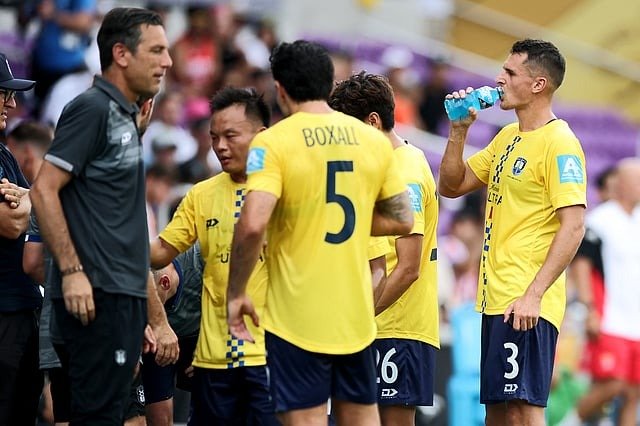
FIFA Confirms Mandatory Hydration Breaks for 2026 World Cup
<p><strong>Mandatory 3-Minute Hydration Breaks Confirmed for 2026 FIFA World Cup</strong></p><p>FIFA has announced a significant change to match regulations for the 2026 Football World Cup, confirming that mandatory three-minute hydration breaks will be enforced in every match. The decision is part of a broader push to prioritise player welfare as the tournament will be staged across Canada, Mexico, and the United States during the peak of the summer season.</p><p>Under the new rule, referees will stop play around the 22nd minute of each half to allow players to take a hydration break. Crucially, this stoppage will apply to all matches, regardless of weather conditions, stadium design, or whether the venue has air conditioning or a retractable roof.</p><p>The move reflects FIFA’s growing emphasis on player health and safety, particularly in response to concerns raised during recent international tournaments played in hot and humid conditions.</p><h3>Lessons from Recent Tournaments</h3><p>The decision follows challenges faced during the 2025 FIFA Club World Cup in the United States, where extreme heat and humidity affected several matches. Players and coaches raised concerns about physical strain, dehydration, and recovery times, prompting FIFA to reassess its existing cooling-break protocols.</p><p>During the Club World Cup, FIFA responded by lowering the temperature threshold required for water or cooling breaks and by ensuring more water, ice packs, and towels were placed around the pitch. These measures were effective but reactive, leading officials to consider a more consistent and proactive solution for future tournaments.</p><p>The 2026 World Cup will be hosted during the Northern Hemisphere summer, and with matches scheduled across different climate zones—from humid coastal cities to hot inland venues—FIFA decided that a uniform approach would be safer than relying solely on temperature-based triggers.</p><h3>How the New Rule Will Work</h3><p>Under the new regulation, referees will pause play approximately 22 minutes into each half. Each hydration break will last around three minutes, giving players enough time to drink fluids, cool down, and receive brief medical attention if needed.</p><p>FIFA officials clarified that the stop will be mandatory in every match, not only those played in extreme heat. This standardised approach ensures fairness and removes any ambiguity around when breaks should be taken.</p><p>However, referees will retain some flexibility. If there is an injury stoppage or a prolonged interruption shortly before the 22-minute mark, the referee may choose to merge the hydration break with that stoppage. According to FIFA, such situations will be handled at the referee’s discretion, based on match flow and player safety.</p><h3>Simplifying Previous Rules</h3><p>Previously, FIFA allowed cooling or hydration breaks only when temperatures crossed a specific threshold, once defined as 32°C (89.6°F) on the Wet Bulb Globe Temperature (WBGT) scale. This system factored in temperature, humidity, wind speed, and sunlight but was often criticised for being complex and inconsistently applied.</p><p>FIFA described the new hydration break policy as a “streamlined and simplified version” of the earlier approach. By making the breaks automatic and time-based, the governing body aims to eliminate delays in decision-making and ensure that player welfare measures are applied uniformly.</p><p>This also reduces pressure on match officials, who previously had to monitor weather data and decide whether conditions warranted a cooling break during play.</p><h3>Why Player Welfare Is Central</h3><p>Modern football is faster and more physically demanding than ever. Players cover greater distances at higher intensities, making hydration and recovery increasingly important, especially in tournament football where matches are played every few days.</p><p>Medical experts have long warned that dehydration and heat stress can significantly increase the risk of muscle injuries, cramps, heat exhaustion, and reduced cognitive performance. By introducing scheduled hydration breaks, FIFA hopes to reduce these risks and help players maintain performance levels throughout matches.</p><p>The break also gives team medical staff a brief window to check on players showing early signs of fatigue or distress—something that is difficult to do during continuous play.</p><h3>Broadcaster-Friendly Scheduling</h3><p>Interestingly, the new rule is also expected to benefit broadcasters. FIFA confirmed that the change was first discussed publicly when Manolo Zubiria, FIFA’s chief tournament officer for the 2026 World Cup, addressed broadcasters in a dedicated meeting.</p><p>From a broadcast perspective, fixed hydration breaks make match timelines more predictable. Advertisers, production teams, and broadcasters can plan coverage more efficiently, potentially slotting in short replays, analysis segments, or graphics during the stoppage without disrupting match flow.</p><p>This predictability is especially valuable for a tournament of the World Cup’s scale, where matches are broadcast across multiple time zones to millions of viewers worldwide.</p><h3>Not Just About Heat</h3><p>One notable aspect of the policy is that hydration breaks will apply even in climate-controlled stadiums. This reinforces FIFA’s view that hydration is not only about heat but about maintaining peak physical condition throughout high-intensity matches.</p><p>Even in air-conditioned venues, players can still lose significant fluids due to exertion alone. The universal application of the rule ensures consistency across all venues and removes any perception of unequal treatment based on location.</p><h3>What Fans Can Expect</h3><p>For fans, the hydration breaks will slightly alter the rhythm of matches but are unlikely to disrupt the overall experience significantly. Similar pauses have already become familiar in tournaments affected by heat, and most supporters recognise the importance of safeguarding player health.</p><p>The breaks may also add a subtle tactical element, allowing coaches to give quick instructions or adjust on-field organisation without using a formal timeout—though FIFA will closely monitor to ensure the pauses are not abused for extended tactical coaching.</p><h3>A Sign of Changing Football Norms</h3><p>FIFA’s decision signals a broader shift in how elite football views player welfare. As climate conditions become more unpredictable and athletic demands increase, tournament organisers are being forced to adapt long-standing traditions to modern realities.</p><p>With the 2026 World Cup set to be the largest in history, featuring more teams and more matches, such measures could prove essential in maintaining quality, competitiveness, and safety throughout the tournament.</p><p>Ultimately, FIFA’s mandatory hydration breaks reflect a growing recognition that protecting players’ health is not a luxury—but a necessity for the future of the game.</p>