

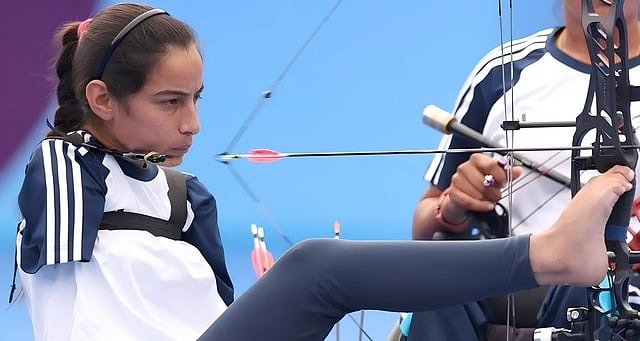
India’s Armless Archer Sheetal Makes History with Able-Bodied Team Selection
<h3><strong>Why Sheetal Devi’s Historic Achievement Is So Special</strong></h3><p>It began as a small dream in the mountains of Jammu and Kashmir — and today, it has become a story that inspires an entire nation.</p><p><strong>Sheetal Devi</strong>, India’s <strong>armless para-archer</strong>, has made history by becoming the <strong>first Indian para-athlete ever selected for the able-bodied junior national team</strong>. At just <strong>18 years old</strong>, she finished third in the <strong>national selection trials</strong> in Haryana for the <strong>Asia Cup in Jeddah</strong>, competing on equal terms with 60 able-bodied archers.</p><p>Her success isn’t just a sporting milestone — it’s a powerful reminder that <strong>determination can defy even the toughest limitations</strong>.</p><h3><strong>Competing — and Winning — on Equal Terms</strong></h3><p>At the national trials, Sheetal scored <strong>703 points (352 + 351)</strong>, tying with top qualifier <strong>Tejal Salve</strong>. The final rankings saw Salve finish first with <strong>15.75 points</strong>, followed by <strong>Vaidehi Jadhav (15.75)</strong>, and Sheetal in <strong>third with 11.75</strong>, just ahead of Maharashtra’s <strong>Gyaneshwari Gadhe (11.5)</strong>.</p><p>The competition was held under <strong>identical conditions</strong> for all participants — no exceptions, no modifications. Sheetal’s performance placed her among India’s best young archers, and her selection sent waves of pride across the country.</p><p>Prominent industrialist <strong>Anand Mahindra</strong> captured the nation’s sentiment perfectly when he posted:</p><blockquote><p>“Sheetal, I never had ANY doubt that you were ‘able-bodied.’ In fact, you are more able-bodied than all the rest of us... and your heart is the strongest. You make India proud.”</p></blockquote><h3><strong>From Paralympic Podium to New Frontiers</strong></h3><p>Before this groundbreaking achievement, Sheetal had already proven her excellence on the international stage. At the <strong>Paris Paralympics</strong>, she won a <strong>bronze medal</strong> in the <strong>mixed team compound event</strong> alongside <strong>Rakesh Kumar</strong>, edging Italy by a single point (156–155).</p><p>In the <strong>individual compound category</strong>, she scored <strong>703 points</strong>, missing the <strong>world record</strong> by just one.</p><p>Her list of achievements is already extraordinary:</p><p> <strong>Two golds and one silver</strong> at the <strong>2022 Asian Para Games</strong></p><p> <strong>Silver medal</strong> at the <strong>2023 World Archery Para Championships</strong> in the Czech Republic</p><p><strong> Para World Compound Champion</strong> title in Guangzhou (2025)</p><p>Each of these victories has reinforced her reputation as one of <strong>India’s most exceptional para-athletes</strong> — and now, she’s setting new benchmarks by competing among able-bodied champions.</p><h3><strong>The Power of Perseverance</strong></h3><p>Sheetal’s journey began in <strong>Kishtwar, Jammu and Kashmir</strong>, where she was <strong>born without arms</strong>. Rather than seeing her condition as a limitation, she learned to <strong>shoot with her feet</strong> — developing incredible balance, control, and precision through relentless training.</p><p>Her path has been filled with obstacles few could imagine. When the <strong>World Archery Federation</strong> changed its rules to ban archers from touching their heel to the bow, her technique was suddenly deemed non-compliant. Overnight, years of training became obsolete.</p><p>“She had to start from zero again,” said her coach, <strong>Gaurav Sharma</strong>, who trains her at the <strong>Shri Mata Vaishno Devi Shrine Board Sports Complex</strong> in Katra.</p><blockquote><p>“The new method required more control and balance. Her leg often hurt, but she never complained. She simply refused to give up.”</p></blockquote><p>That determination became her greatest weapon.</p><h3><strong>Defying Doubts, Redefining Ability</strong></h3><p>After a series of injuries and setbacks, many doubted whether Sheetal could return to her peak form. But she silenced critics in her own quiet way.</p><blockquote><p>“I missed practice sessions, lost matches, and people said my time was over,” she wrote on social media. “But my coach told me, we don’t need to reply — our arrows will answer.”</p></blockquote><p>And indeed, her arrows did. Her focus and composure under pressure continue to inspire not only athletes with disabilities but anyone who faces adversity.</p><p>Coach Sharma proudly remarked:</p><blockquote><p>“I was surprised when her name appeared on the final list — it’s unbelievable that a para-athlete is now competing equally with India’s best able-bodied archers.”</p></blockquote><h3><strong>More Than a Medal — A Message of Inclusion</strong></h3><p>Sheetal’s qualification isn’t just about sports; it’s about <strong>breaking barriers</strong> and changing how society perceives ability. Her selection proves that <strong>talent and discipline matter more than physical limitations</strong>, and that <strong>inclusive opportunities</strong> can unleash extraordinary potential.</p><p>Her journey also highlights the need for <strong>better infrastructure and coaching systems</strong> for para-athletes in India — to ensure that stories like hers are no longer rare exceptions but common triumphs.</p><p>As the team prepares for upcoming events, including the <strong>2026 Asian Para Games</strong> and the <strong>senior able-bodied trials</strong>, Sheetal’s dual participation in both categories marks a new era for Indian sport — one defined by <strong>integration, equality, and resilience</strong>.</p><h3><strong>The Spirit of a Champion</strong></h3><p>For Sheetal Devi, every arrow she releases carries a message far beyond the target. It speaks of strength born from struggle, hope born from hardship, and dreams that soar higher than any limitation.</p><p>Her story isn’t just about archery — it’s about rewriting what “able” truly means.</p><p>As she put it herself:</p><blockquote><p>“When I started, I just wanted to compete with others. Now, I realize — I was never competing with them. I was competing with myself.”</p></blockquote><p>At 18, she’s already changed the game. The world will be watching what she does next.</p>