

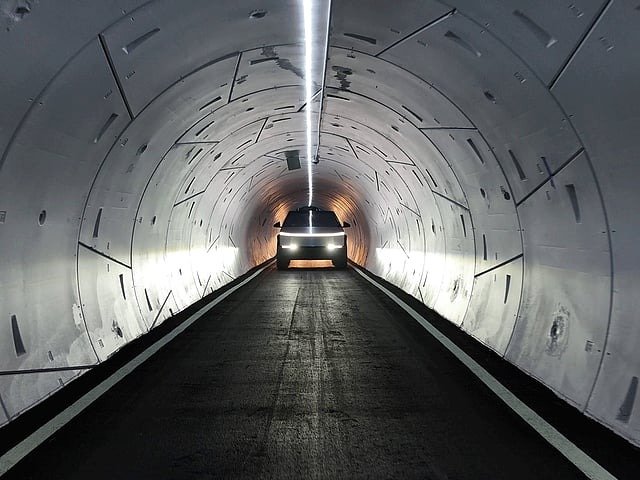
Dubai Loop: Elon Musk’s High-Speed Underground Transit Coming in 2026
<h3><strong>Dubai Loop: The UAE’s Next Leap in Futuristic Transport</strong></h3><p>Dubai is once again setting a global benchmark in futuristic innovation. In collaboration with <strong>Elon Musk’s The Boring Company</strong>, the emirate is preparing to launch the <strong>Dubai Loop</strong> — a cutting-edge underground transit network that promises to transform daily commuting. Scheduled for <strong>operation by mid-2026</strong>, the Dubai Loop aims to deliver ultra-fast, clean, and efficient travel beneath the city’s bustling streets.</p><h4><strong>What Is the Dubai Loop?</strong></h4><p>The <strong>Loop</strong> is a high-speed underground transportation system powered by <strong>Tesla electric vehicles</strong>. Unlike traditional metros, which stop at multiple stations along a fixed route, Loop cars transport passengers <strong>directly from point to point</strong>. This design eliminates unnecessary stops, dramatically reducing travel times and congestion.</p><p>Each tunnel is built to handle <strong>autonomous Tesla vehicles</strong> capable of speeds up to <strong>160 km/h (100 mph)</strong>. The result is a system that blends the speed of air travel, the privacy of private transport, and the sustainability of electric mobility — all within a sleek underground network.</p><h4><strong>Why Dubai?</strong></h4><p>Dubai’s choice as the first Middle Eastern city for this project reflects its global reputation as a <strong>smart city pioneer</strong>. The Dubai Loop aligns with the emirate’s <strong>Clean Energy Strategy 2050</strong> and <strong>Urban Master Plan 2040</strong>, which focus on sustainability, innovation, and seamless mobility.</p><p>From autonomous taxis to aerial drones, Dubai has long been a testing ground for next-generation transportation. The Loop now adds a new dimension — <strong>underground high-speed travel</strong> that reduces surface congestion and cuts emissions.</p><h4><strong>How Will It Work?</strong></h4><p>The pilot phase of the Dubai Loop spans <strong>17 kilometres</strong>, connecting <strong>11 key stations</strong> across the city. Operated jointly by <strong>Dubai’s Roads and Transport Authority (RTA)</strong> and <strong>The Boring Company</strong>, it will initially carry over <strong>20,000 passengers per hour</strong>. Once fully expanded, it could serve more than <strong>100,000 passengers hourly</strong>.</p><p>Passengers will enter small, digitally managed stations — some no larger than two parking spaces — where Tesla vehicles will be waiting to take them directly to their destinations. The model emphasizes <strong>speed, convenience, and minimal waiting time</strong>, making it unlike any metro or tram system currently in operation.</p><h4><strong>Safety and Sustainability</strong></h4><p>Safety is a top priority for The Boring Company. Each tunnel features <strong>emergency exits</strong>, <strong>fire detection systems</strong>, and <strong>redundant ventilation</strong> to ensure passenger protection. The system also connects to a <strong>24/7 Operations Control Centre</strong>, providing real-time monitoring and rapid emergency response.</p><p>Tunnels are inherently safe structures — they move uniformly with the earth during seismic activity, avoiding the collapse risks seen in surface-level buildings. The Loop’s zero-emission design, using <strong>Tesla EVs</strong>, also supports Dubai’s ambition to become one of the world’s most sustainable cities.</p><h4><strong>What’s the Difference from a Metro?</strong></h4><p>While metros operate on fixed schedules and stop at every station, the <strong>Loop functions like an underground highway</strong>. Each passenger (or small group) boards a vehicle that goes straight to their destination — no intermediate stops, no delays. Stations are compact and distributed across commercial and residential hubs, offering unmatched accessibility.</p><h4><strong>The Boring Company’s Track Record</strong></h4><p>Elon Musk’s Boring Company has already proven its concept with the <strong>Vegas Loop</strong> in Las Vegas. Since its launch in 2021, the system has safely transported <strong>over 3 million passengers</strong>. It’s now expanding to cover <strong>110 kilometres with 104 stations</strong>, connecting the city’s airport, stadium, and downtown core. A similar project, the <strong>Music City Loop</strong> in Nashville, is set to begin construction in late 2025.</p><h4><strong>The Road Ahead</strong></h4><p>Construction of the Dubai Loop is expected to begin soon, with operations starting by <strong>Q2 2026</strong>. Once completed, it will redefine Dubai’s public transportation landscape, offering a fast, clean, and high-capacity transit alternative.</p><p>In the long term, the Loop could become a <strong>citywide network</strong>, potentially integrating with other transport systems like the Dubai Metro and autonomous taxis — positioning Dubai as a <strong>global model for high-speed, sustainable urban mobility</strong>.</p><h3><strong>At a Glance: Dubai Loop Facts</strong></h3><p><strong>Launch:</strong> Q2 2026</p><p><strong>Length:</strong> 17 km (pilot phase)</p><p><strong>Stations:</strong> 11</p><p><strong>Capacity:</strong> 20,000 passengers/hour (pilot)</p><p><strong>Top Speed:</strong> 160 km/h</p><p><strong>Technology:</strong> Tesla all-electric vehicles</p><p><strong>Partners:</strong> The Boring Company, RTA, Vy Capital</p><p> </p>