

Dubai Metro: 9,000 Cameras and AI Keep 850,000 Riders Safe
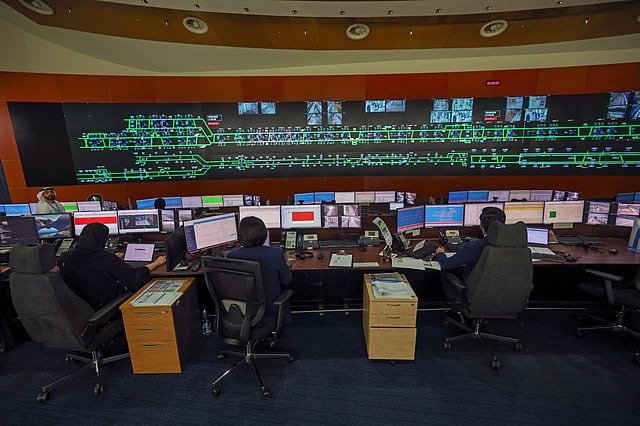
<p><strong>Dubai, September 20, 2025</strong> – In the heart of Dubai’s public transport system lies an ultra-modern <strong>Operations Control Centre (OCC)</strong> in Rashidiya — the nerve centre that keeps the world’s longest driverless metro running smoothly. From here, a team of just 20 staff monitors the daily movement of <strong>850,000 passengers, 101 trains, and 53 stations</strong> using over <strong>9,000 cameras and advanced artificial intelligence systems</strong>.</p><h3>Round-the-Clock Vigilance</h3><p>The OCC functions 24/7, ensuring seamless operations across both the Red and Green Lines. Massive digital screens display live feeds from thousands of cameras, covering platforms, carriages, depots, and entry points. Each operator supervises a dedicated segment of the network, monitoring real-time activities.</p><p>“If any incident happens, our staff act immediately, following established procedures to restore normal service,” explained <strong>Hassan Al Mutawa, Director of Rail Operations at Dubai’s Roads and Transport Authority (RTA)</strong>, during a media tour of the centre.</p><p>Supporting this small team is a wider workforce of <strong>1,800 personnel</strong> spread across operations, maintenance, and safety, all working to maintain Dubai Metro’s reputation as one of the most reliable transport systems worldwide.</p><h3>Layers of Control</h3><p>The system runs with military precision through three levels of supervision:</p><p><strong>First Layer – Service Operations</strong>: Supervisors track all trains and stations during operational hours (5am–midnight, extended to 1am on weekends and special occasions).</p><p><strong>Second Layer – Depot Monitoring</strong>: Dedicated teams oversee maintenance areas, manage alarms, and track technical issues.</p><p><strong>Third Layer – Duty Managers</strong>: They coordinate across the network, making high-level operational decisions.</p><p>This structure ensures that even with minimal staff on-site, the system operates without disruption.</p><h3>Security Partnership with Dubai Police</h3><p>Tightly integrated with the Dubai Police, the OCC also houses a <strong>restricted-access surveillance room</strong> operated by law enforcement. This enables rapid response to emergencies, from medical incidents to suspicious activity.</p><p>“We monitor the operation in coordination with police. If anything happens, they communicate directly with station staff to resolve it quickly,” said Al Mutawa.</p><h3>Technology Driving Efficiency</h3><p>The OCC’s efficiency relies heavily on <strong>AI, predictive analytics, and sensor-driven monitoring systems</strong>. These tools help maintain Dubai Metro’s impressive <strong>99.7% punctuality rate</strong>, ranking it among the world’s top five metro networks.</p><p>Sensors continuously monitor key assets — from train engines to track systems — predicting failures before they occur. This predictive maintenance approach reduces downtime, improves safety, and cuts costs.</p><p>Alongside train operations, the OCC also manages <strong>fire systems, lighting, escalators, elevators, and environmental controls</strong> across stations, ensuring comfort and safety for passengers.</p><h3>Lessons from the 2024 Floods</h3><p>Perhaps the biggest test in Dubai Metro’s history came in <strong>April 2024</strong>, when record-breaking rainfall — the heaviest in 75 years — triggered widespread flooding. Several stations were forced to shut temporarily, severely disrupting services.</p><p>“The flood was a new experience for Dubai. We managed to restore operations quickly, but it pushed us to completely rethink our emergency plans,” recalled Al Mutawa.</p><p>In response, the RTA overhauled its <strong>emergency preparedness protocols</strong>, introducing contingency plans for heavy rain, extreme heat, and strong winds. These plans are now tested regularly to ensure readiness.</p><h3>Constant Upgrades</h3><p>To keep pace with rapid growth in demand, the OCC undergoes continuous upgrades. Recent improvements include:</p><p>Enhanced <strong>train movement control systems</strong></p><p>Upgrades to the <strong>Nol card ticketing network</strong></p><p>Expanded <strong>AI-driven monitoring tools</strong></p><p>“We are constantly updating back-end systems to prevent problems before they affect passengers,” Al Mutawa noted.</p><h3>A Massive Scale of Operations</h3><p>Since its launch on <strong>09/09/09</strong>, the Dubai Metro has transported more than <strong>2.4 billion passengers</strong> across <strong>4.3 million journeys</strong>. In the <strong>first half of 2025 alone, 143.9 million commuters</strong> traveled via the Metro, cementing its role as the backbone of Dubai’s public transport system.</p><p>To manage fluctuating demand, the OCC adjusts train frequency dynamically — increasing services during peak hours and scaling back during quieter periods. This flexibility ensures comfort for both daily commuters and international visitors.</p><h3>Looking Ahead: Blue Line Expansion</h3><p>While expansion plans for the <strong>Dubai Metro Blue Line</strong> are progressing, the current OCC in Rashidiya — supported by a backup facility in Jebel Ali — continues to focus on delivering world-class service.</p><p>“My responsibility is to ensure every passenger travels safely and comfortably,” said Al Mutawa. “We depend on smart systems, AI, and the dedication of our staff to make that possible.”</p><h3>Conclusion</h3><p>Behind the sleek trains and spotless stations of Dubai Metro lies a world of advanced technology, round-the-clock surveillance, and highly trained staff. With <strong>9,000 cameras, predictive AI, and seamless coordination with police</strong>, the OCC ensures that millions of passengers can travel safely every month.</p><p>As Dubai expands its metro network, this blend of <strong>automation, human expertise, and continuous innovation</strong> will remain central to maintaining its status as one of the world’s most reliable and futuristic transport systems.</p>