
India–UAE flights hit by cancellations as Ethiopia volcano ash heads toward North India
Air travel between India and the UAE has been significantly disrupted after the sudden eruption of Ethiopia’s Hayli Gubbi volcano, which sent a massive ash cloud rising more than 45,000 feet into the atmosphere. The plume, which is drifting across the Red Sea and toward the Indian subcontinent, has forced several airlines to cancel, delay, and reroute flights across northern India and the Middle East.
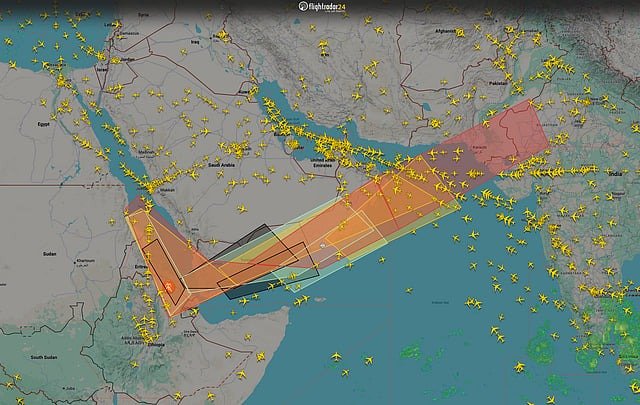
According to meteorological tracking agencies, the ash cloud is expected to reach western and northern India by around 10 pm on Tuesday, impacting regions including Gujarat, Rajasthan, northwest Maharashtra, Delhi, Haryana, Punjab, and eventually the Himalayan belt. Aviation authorities issued urgent advisories due to the potential danger of volcanic ash entering aircraft engines and limiting visibility.
The first eruption in 10,000 years
The violent awakening of the long-dormant Hayli Gubbi volcano, erupting for the first time in more than 10,000 years, triggered immediate flight safety responses worldwide. The high-altitude plume, moving at speeds of 100–120 km/h, contains volcanic ash, sulphur dioxide, and fine rock particles, according to data from IndiaMetSky Weather and Toulouse Volcanic Ash Advisory Centre (VAAC).
Authorities warn the ash cloud may darken skies, increase haze levels, and disturb atmospheric conditions, posing a high risk to aircraft engines and navigation systems. Volcanic ash can melt inside jet turbines, leading to engine failure, which is why even indirect exposure is treated with extreme caution.
Airlines cancel, delay, and divert multiple flights
Following alerts issued by aviation regulators, multiple airlines including Air India, IndiGo, Akasa Air and KLM have suspended or rerouted flights operating through the affected corridor.
Major disruptions include:
Air India
Delhi–Tokyo flight cancelled moments before departure
Kochi–Jeddah and Kochi–Dubai flights suspended
IndiGo
Cochin–Dubai flight 6E1475 grounded
Kannur–Abu Dhabi flight diverted mid-air to Ahmedabad
At least six flights cancelled across networks
Akasa Air
All flights to and from Jeddah, Kuwait, and Abu Dhabi on 24–25 November cancelled
KLM
Amsterdam–Delhi (KL 871) and Delhi–Amsterdam (KL 872) cancelled
Flight radar tracking shows several mid-air diversions as airlines avoided the ash zone spreading toward West Asia and northern India.
Passenger advisory issued
Chhatrapati Shivaji Maharaj International Airport (Mumbai) has issued a public advisory urging passengers to verify their flight schedules in advance, warning that volcanic ash may impact international routes. The airport asked passengers to follow real-time updates and contact airlines directly before heading to terminals.
Airlines have assured customers that they are working to minimise travel disruption and will assist affected travellers with rebooking and support.
DGCA announces strict safety protocols
India’s Directorate General of Civil Aviation (DGCA) has instructed airlines to:
Report any suspected ash encounters, engine anomalies, or cabin haze
Inspect runways, taxiways and aprons if ash is detected
Use advanced meteorological and satellite monitoring continuously
The aviation regulator warned that aircraft operating in altitudes affected by ash are at high risk of engine stall, reduced visibility, and abrasion to cockpit windows.
Impact beyond India and the UAE
In Ethiopia’s Afar region, areas around the volcano have been blanketed in black ash, affecting the village of Afdera. Moderate tremors were recorded around the Erta Ale volcanic zone, close to the eruption site.
Before shifting toward India, the ash plume drifted across the Red Sea, affecting parts of Oman, Yemen, and the Arabian Peninsula, where airlines issued precautionary notifications.
Although the eruption itself has subsided, satellite images confirm that the residual ash continues to move eastward, causing aviation uncertainty across the region.
Continuing developments
Meteorological agencies warn that haze and reduced visibility could affect airports tonight and Wednesday morning. Passengers traveling between the UAE, India, and Europe are advised to remain prepared for delays.
The Toulouse VAAC confirmed that the Hayli Gubbi volcano last erupted 10,000–12,000 years ago, making this event historically significant and unpredictable.
Air travel experts suggest that the situation will remain closely monitored for the next 24–48 hours, with more cancellations possible if ash levels increase.
Related News